

HIPAA Compliant Chatbot: A Plain Guide for US Healthcare Teams
Ready to Build Something Great?
Book a free strategy call with our team and let's turn your idea into reality.
Share This Blog
A HIPAA compliant chatbot answers patient questions fast, and it keeps private details safe. At first, that sounds simple. However, many clinics buy a bot first and ask about privacy later. Consequently, that order causes trouble. In this guide, you will learn what makes a bot safe. You will also see where bots leak data. Finally, you will learn how to pick a good one. Everything about a HIPAA compliant chatbot is written in plain words.
The Moment a Patient Types Their Name, the Rules Apply
HIPAA is a US law. It protects health details that can point to one person. These details are called protected health information, or PHI.
A name becomes PHI when it sits next to a health detail. A phone number, an email, or a birth date can do the same. Even "I need to rebook my knee scan" counts once the bot knows who is typing.
Because of this, most healthcare chatbot tools touch PHI on day one. A bot that only shares office hours may not, though. However, a bot that books visits, checks insurance, or sends lab reminders almost always does.
Two roles matter for any HIPAA compliant chatbot. The clinic is the covered entity. The company that builds or hosts the bot is the business associate. Therefore, both must follow the rules. As a result, you cannot hand the risk to a vendor and walk away.
Why No Bot Can Hold an Official HIPAA Badge
Here is a surprise. The government does not certify any product as HIPAA compliant. No official seal exists. So when a vendor says "fully certified," be careful.
Compliance in a HIPAA compliant chatbot describes how the bot is built, run, and managed. Furthermore, it covers how your staff use it. In other words, it is a habit, not a sticker.
A true HIPAA compliant AI chatbot shows its work. It follows three groups of safeguards:
- Administrative: written rules, staff training, and a plan for breaches.
- Physical: locked servers and controlled access to devices.
- Technical: strong logins, encryption, and activity records.
Furthermore, the vendor must sign a business associate agreement, or BAA. This contract says the vendor will protect PHI as the law demands. Without a BAA, do not share a single patient detail.
Following One Message Through a Safe Chat
Let us trace a real example. A patient types, "This is Maria Lopez. Can I move my Tuesday heart check-up?"
First, the message travels over an encrypted line. Next, the bot checks that Maria is who she says she is. Then it pulls only the Tuesday slot, not her whole chart. After that, it offers new times.
Meanwhile, the system writes a log. In addition, the log shows who asked, what the bot did, and when. Later, the chat sits in a locked space. When the keep-time ends, the system deletes it.
Each step supports patient data security . If one step fails, the whole chain breaks. Therefore, ask your vendor to walk you through this exact path in their HIPAA compliant chatbot.
Five Quiet Leaks Hiding in Everyday Bots
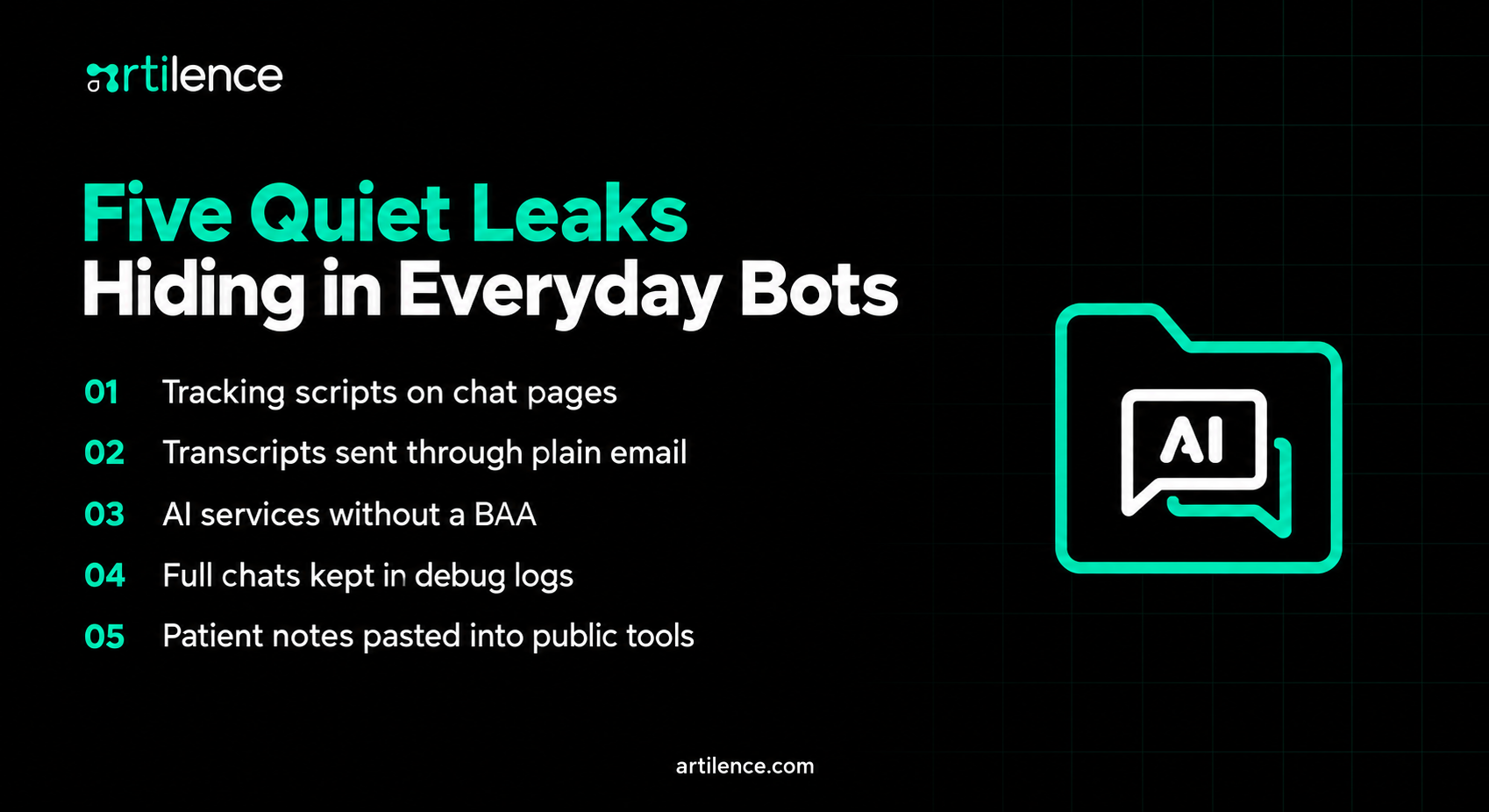
Most breaches are not movie-style hacks. Instead, even a HIPAA compliant chatbot can have small gaps that nobody checked. Watch for these five:
- Tracking tools on the chat page. Ad scripts can send patient clicks to outside firms. Ask your web team to audit them.
- Transcripts sent by plain email. Because email is often not secure, use a protected portal link instead.
- An AI model with no agreement. If the bot sends text to a public AI service without a BAA, PHI leaves your control.
- Messy logs. Debug files sometimes keep full chats forever, so set a clear deletion rule.
- Staff shortcuts. A nurse who pastes notes into a free chat tool creates a breach in seconds.
If a breach happens, HIPAA expects prompt notice. In general, affected people must hear within 60 days of discovery. So a fast response plan matters. Strong patient data security habits make that plan easier to follow.
What the AI Brain Should Never See
Today, modern bots use large language models. The model writes the replies. However, it can also log or learn from what it reads. So guard what goes in.
An AI chatbot for healthcare should follow four rules:
- Send the minimum. Share only the data needed, because each task needs little.
- Mask names. Swap a name for a code before the model reads it.
- Block training. Patient chats must never train a public model.
- Use a private setup. Pick hosting that does not keep long-term memory of prompts.
Also, a bot should never diagnose. It can share general facts and route people to staff. For urgent words like "chest pain," it should tell the patient to call 911. A HIPAA compliant AI chatbot respects these limits by design.
A Ten-Minute Test for Any Vendor Demo
Do not just listen to a sales pitch. Instead, ask the vendor to prove each claim live:
- Show the BAA before the demo ends.
- Point to where chats live and who can open them.
- Delete a test chat on screen.
- Open the activity log for that same chat.
- Type "chest pain" and watch the reply.
- Name the AI model and say whether it keeps data.
A strong vendor smiles and shows you. A weak one, however, changes the subject. Consequently, this short test saves months of regret. It also helps you choose a HIPAA compliant chatbot with confidence.
Low, Medium, High: Sorting Bot Jobs by Risk
However, not every task needs the same level of care. So sort jobs into three groups.
Low risk: office hours, parking, and general service questions. The bot never asks who the patient is. Therefore, little PHI is involved.
Medium risk: booking visits, insurance checks, and reminders. Here the bot knows names and times. As a result, full safeguards are a must.
High risk: test results, symptoms, and mental health topics. These need the strictest controls. They also need a quick handoff to a human.
Start your HIPAA compliant chatbot with low-risk jobs. Then move up one level at a time. This path builds trust with patients and staff. Moreover, it lets your team learn before the stakes rise.
What Patients See Before They Trust a Chat Window
Patients decide fast. Within seconds, they judge whether a bot feels safe. So the window of your HIPAA compliant chatbot must earn trust.
Start with honesty. Say clearly that the patient is talking to a bot. Next, add a short privacy note in plain words. Then offer a button that reaches a real person at any time.
Also, limit what the bot asks. It should never request a full Social Security number or a card number in chat. Instead, it can send the patient to a secure form. This small habit supports patient data security and calms nervous users. Because trust drives use, a well-built healthcare chatbot often gets more replies from patients.
Who Handles What: Clinic Versus Vendor
Indeed, safe bots need teamwork. Many failures happen because each side thought the other had it covered. Here is a simple split.
The vendor usually handles:
- Encryption and secure hosting
- Activity logs and backups
- Breach alerts sent to you
- Updates and fixes
The clinic usually handles:
- Staff training
- Who gets access, and when it ends
- Which tasks the bot may do
- Checking the logs on a set schedule
Write this split into your contract for the HIPAA compliant chatbot. Then, after that, review it every year. Clear roles keep a healthcare chatbot from becoming nobody's job.
Your First 30 Days With a Safe Bot
A calm start beats a big launch of any HIPAA compliant chatbot. Try this plan:
- First, in week one, map the data the bot will touch, and sign the BAA.
- Next, in week two, build one low-risk job, such as visit reminders.
- Then, in week three, test with staff, using fake patient names.
- Finally, in week four, release to a small group, and read the logs together.
After 30 days, decide what to add next. Because each step is small, problems stay small too.
Keeping the Bot Safe After Launch
Launch day is not the finish line. Rules, staff, and software all change. As a result, a bot that was safe in March can drift by October.
Set a simple rhythm. Each month, read a sample of chats and fix odd replies. Each quarter, review who can open the logs. Likewise, remove anyone who left the team. Every year, run a fresh risk check and retrain staff.
Also, test the "chest pain" reply again after each update. Vendors sometimes change models without much notice. Therefore, ask to hear about every change in writing. A HIPAA compliant AI chatbot stays that way only with steady care. The same is true for any AI chatbot for healthcare that grows over time.
A Quick Word on Artilence
Artilence is a US-headquartered team that builds AI tools and software for healthtech groups. For each AI chatbot for healthcare project, we map the data path first. Then we choose the tools. Overall, we do not sell a magic badge. Instead, we build safeguards, document them, and train your team. If you want a clear plan for your HIPAA compliant chatbot, book a short call with us.
FAQs
What is a HIPAA compliant chatbot?
It is a chat tool that follows HIPAA rules when it handles patient details. It uses encryption, access limits, and activity logs. The vendor also signs a BAA with the clinic.
Is ChatGPT HIPAA compliant?
The free and personal versions are not meant for patient data. Some business plans offer a BAA. Even then, you must sign it and set the tool up correctly.
Does HIPAA apply if a chatbot does not store any data?
Yes, it can. If the bot reads or sends PHI, the rules apply even when nothing is saved. Short-lived data still needs protection.
How do I make a chatbot HIPAA compliant?
Start with a signed BAA and encrypted connections. Add access controls, activity logs, and staff training. Then test the bot with fake patient data before launch.
Do I need a BAA with my chatbot vendor?
Yes, if the vendor touches PHI in any way. The BAA is a legal promise to protect that data. Without it, sharing patient details breaks the rules.
What happens if a chatbot breaks HIPAA rules?
The clinic may face fines, and the fines grow with the level of neglect. You may also need to notify patients and the government. Lost trust can hurt even more than the fine.
Can a chatbot send text messages with patient information?
Standard texts are not secure by default. Keep messages free of health details, and get consent first. A secure portal link is a safer choice.
Can a healthcare chatbot give medical advice?
It should not diagnose or treat anyone. It can share general facts and point patients to staff. For emergencies, it should tell them to call 911.
How much does a HIPAA compliant chatbot cost?
The price depends on features, connections to your systems, and security needs. A simple bot costs less than a custom one tied to your records. A small pilot shows the real cost before you scale.
How long should a chatbot keep chat records?
HIPAA requires you to keep its policy papers for six years. Chat logs depend on state law and on whether they join the patient record. Ask your compliance officer for the right rule.
Artilence Newsletter
Don't worry your email is secure with us, We will use it to share the latest updates straight to your inbox!
By subscribing, you agree to our Privacy Policy.
Ready to Build Something Great?
Book a free strategy call with our team and let's turn your idea into reality.
Related Insights



AI is our language, we speak it fluently. Let's innovate together.




Services
Artilence Newsletter
Don't worry your email is secure with us, We will use to share latest updates straight to your inbox!
By subscribing, you agree to our Privacy Policy.


