


Ready to Build Something Great?
Book a free strategy call with our team and let's turn your idea into reality.
Share This Blog
Enterprise AI chatbots now answer questions at banks, hospitals, and schools every single day. Many buyers want a simple list of winners. However, no single bot wins in every field. A tool that suits a bank can fail in a clinic. This post looks at the top enterprise AI chatbots in finance, healthcare, and education. You will see real examples, clear numbers, and an easy way to compare them.
Why One Bot Cannot Serve Every Industry
Each field has its own rules. As a result, each field needs a different kind of bot.
Banks must stop fraud and follow money laws. Hospitals must protect patient records. Schools must guard student data and keep children safe. Therefore, a general chat tool rarely fits any of them well.
Consumer bots also work alone. Enterprise bots, on the other hand, connect to core systems. They read account data, patient charts, or class records. They also hand hard cases to people.
Think of it like a uniform. A chef's apron works great in a kitchen. However, it does not help in an operating room. In the same way, enterprise AI chatbots must match the job they do.
Four Traits That Separate a Serious Bot From a Toy
Some tools only look smart in a demo. Four traits show which ones are ready for real work.
- Secure access means only approved users can see private records.
- Deep links to your systems let the bot use billing, charts, or grade books.
- Clear logs show who asked what, and what the bot said.
- Human handoff sends tricky questions to a real person.
Without these traits, a bot is just a chat window. With them, it becomes part of daily work. Moreover, these traits lower risk. They also make audits much easier.
AI Chatbots for Finance: Fraud Alerts, Bills, and Trust
Money questions feel personal. People ask about balances, bills, and strange charges. Because of that, AI chatbots for finance must be fast and careful.
The best-known example is Erica from Bank of America. It launched in 2018. By August 2026, the bank said Erica had handled more than 3.6 billion client interactions. More than 1.9 billion of them were tips that the bot sent first. For example, it can point out spending trends or a bill that is due soon.
This proactive style matters. A good bot does not just wait for questions. Instead, it speaks up before a small problem grows.
Finance bots also help staff. Bank of America built EricaAssist for its call center team. It helps agents find answers faster, so each call gets shorter.
Smaller banks and credit unions can use AI chatbots for finance too. They often start with card disputes, loan status checks, and branch hours. Because these tasks repeat daily, a bot can handle them well. Even so, every answer must follow your own fee rules and legal notes.
When you review AI chatbots for finance, ask three questions. Does it flag signs of fraud? Does it explain fees in plain words? Can it pass a tough case to a banker quickly?
AI Chatbots for Healthcare: Visit Notes, Intake, and Less Paperwork
Doctors spend a huge part of their day on notes. So, AI chatbots for healthcare often start there, not with patient chat.
Microsoft Dragon Copilot is a good example. It grew out of Nuance speech tools. During a visit, the tool listens and then drafts the clinical note. Referral letters and after-visit summaries are also on its task list. Early users told Microsoft they saved about five minutes per patient visit.
Other bots greet patients before they arrive. They collect symptoms, confirm insurance, and book follow-ups. Still, a clinic bot must never act like a doctor. It should share facts and send urgent cases to staff.
Smaller practices can gain from AI chatbots for healthcare as well. For example, a dental office can use one to confirm visits and send prep steps. As a result, fewer patients miss appointments, and front desk staff get a calmer day.
Privacy comes first in this field. In the United States, HIPAA protects patient data. Therefore, ask each vendor for written proof of its privacy controls before any demo.
Integration also matters. Check that the bot works with your own record system before you sign. A great tool is useless if it cannot reach the chart.
AI Chatbots for Education: Tutors, Advisors, and Help Desks
Schools use bots in two main ways. Some bots teach. Others guide students through office tasks. Both are growing fast, so AI chatbots for education now cover many roles.
Khanmigo, from Khan Academy, is a tutor. The nonprofit launched it in 2023. It does not just hand over answers. Instead, it asks guiding questions, so students think for themselves. Teachers also get a planning helper inside the same tool.
Georgia State University shows the office side. Its bot, Pounce, texted incoming students about forms, bills, and deadlines. In a study, students who got Pounce were 3.3 percentage points more likely to enroll on time. Also, fewer than one percent of student messages needed a staff reply.
Smaller schools can use AI chatbots for education too. A bot can answer parent questions about bus times, lunch menus, and school calendars. That frees office staff to help families who need a real conversation.
Student safety is the key test. Ask how the bot handles children's data and sensitive topics. In addition, ask how teachers can review chats.
A Five-Point Scorecard for Comparing the Top Enterprise AI Chatbots
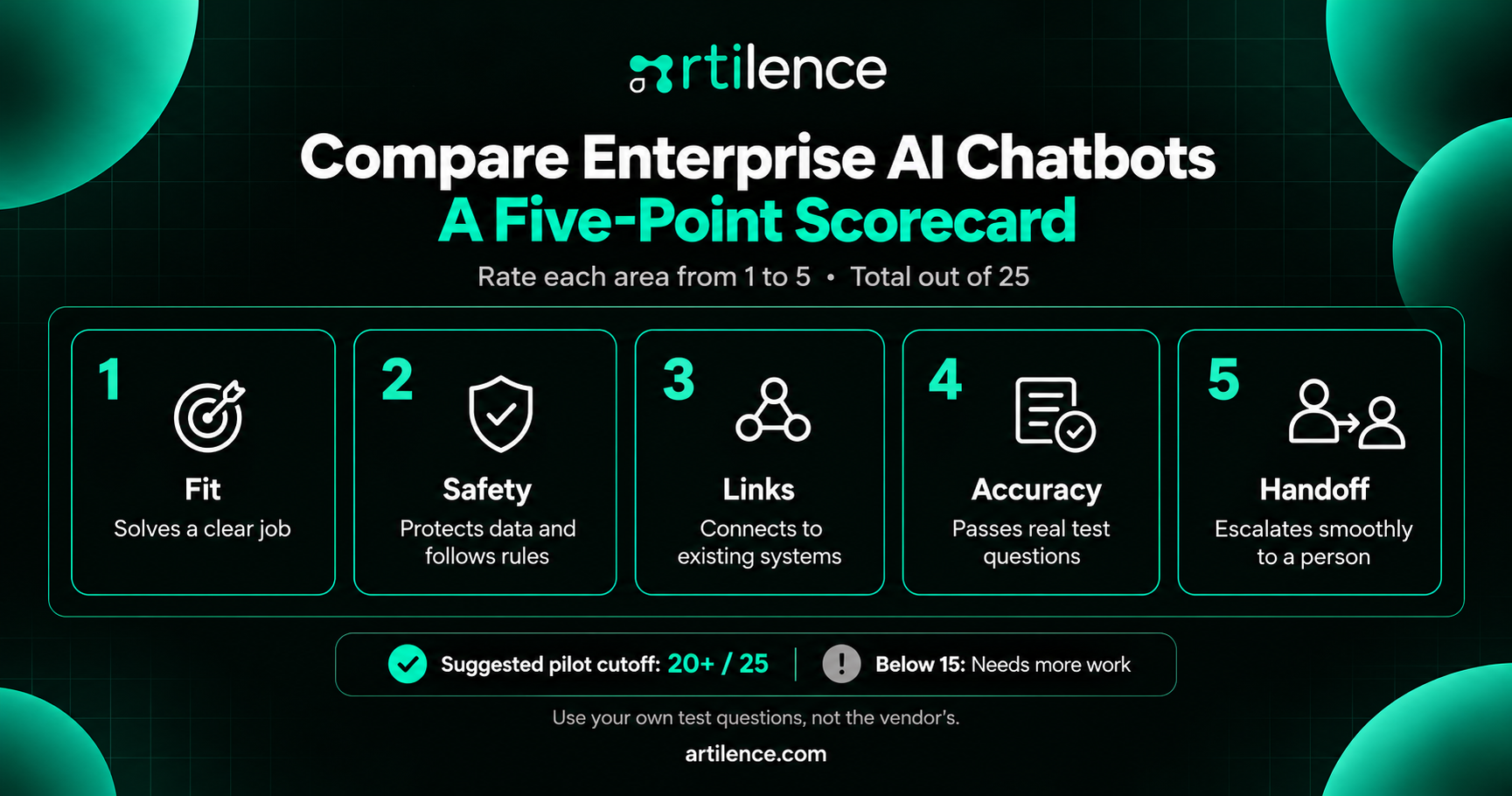
Lists of names only help so much. A scorecard helps more. Rate each bot from one to five on these points:
- Fit: does it solve one clear job in your field?
- Safety: does it protect private data and follow your rules?
- Links: does it connect to the systems you already use?
- Accuracy: does it answer your own test questions correctly?
- Handoff: does it pass hard cases to a person smoothly?
Add up the scores. Then compare the top enterprise AI chatbots on your short list. A bot with 20 or more points deserves a pilot. A bot below 15 likely needs more work.
Use your own test questions, not the vendor's. For example, a bank can test odd fee questions. A clinic can test confusing refill requests. As a result, you see how the bot acts in your world.
What a 45-Day Pilot Should Prove
A pilot keeps risk small. Pick one task, not ten. For example, a bank might start with card disputes. A clinic piloting AI chatbots for healthcare might start with visit notes. A school piloting AI chatbots for education might start with admissions texts.
Set three goals before launch. Choose time saved, answer accuracy, and user happiness. Then check them each week. If the numbers stay flat, change the plan early.
Also keep a person in the loop. Staff should read a sample of chats every week. This habit catches errors fast, and it builds trust with your team.
Finally, write down what you learn. Those notes will guide your next rollout.
Five Buying Mistakes That Waste Budget
Many projects fail for simple reasons. Here are five to avoid.
- Teams buy for the demo instead of the daily job.
- Leaders skip the data check, so the bot learns from messy files.
- Managers forget staff training, and workers ignore the tool.
- Projects track chat counts only. Yet usage alone does not prove value.
- Companies launch everywhere at once and cannot find the cause of problems.
In short, a small, well-measured start beats a big, blurry one.
Build, Buy, or Blend?
Ready-made tools launch faster. Custom builds fit your workflow better. Because of this, many teams blend both. They buy a proven base, and then add custom links to their own data.
Artilence builds custom AI automation and chatbots for teams in regulated fields. Each project starts with your workflow, not a template. If you are weighing enterprise AI chatbots, the Artilence team can map your needs first.
Where Enterprise Chatbots Are Heading Next
Three shifts are underway. First, bots are becoming agents. They will not just answer. They will also act, such as filing a form or booking a visit.
Second, buyers want proof. They will ask how a bot was tested and how it handles mistakes. Third, human oversight will stay important. Even strong bots need people to guide them.
Voice is also growing. Many people would rather speak than type. That is true for nurses on rounds and parents on the go. As a result, bots that listen and talk back will reach more users.
Your Next Step This Week
Start small. Pick one field, one task, and one goal. Then score two or three of the top enterprise AI chatbots with the scorecard above. After that, run a short pilot and measure the results. With a clear plan, enterprise AI chatbots can save time without adding risk.
Frequently Asked Questions
What are the top enterprise AI chatbots?
The best choice depends on your field. Erica leads in banking, and Dragon Copilot is a strong name in clinical notes. Khanmigo is well known for tutoring.
What is an enterprise AI chatbot?
It is a business-grade chat tool that connects to your systems. Your security rules guide it, and every chat is logged. Tough cases go to people.
What is the best AI chatbot for banking?
Erica is the best-known option, but it serves Bank of America clients. Other banks build their own or choose vendors. Fraud checks and plain answers matter most.
What is the best AI chatbot for healthcare?
Many clinics start with note-taking tools like Dragon Copilot. Others use intake bots for scheduling and forms. Pick one that protects patient data and fits your records system.
What is the best AI chatbot for students?
Khanmigo is a popular tutor that guides with questions. Schools also use bots like Pounce for admissions texts. The right pick depends on the job.
Is ChatGPT an enterprise AI chatbot?
The public version is a consumer tool. Business plans add more controls and admin settings. Always check privacy terms before sharing any private data.
How much do enterprise AI chatbots cost?
Prices vary by user count, chat volume, and custom work. Some vendors charge per seat, while others charge a flat fee. A small pilot shows the real cost.
Are enterprise AI chatbots secure?
They can be, when built with care. Look for encryption, access controls, and clear logs. Also ask how the vendor handles your data after each chat.
How long does it take to launch an enterprise AI chatbot?
A focused pilot can take a few weeks. Larger rollouts take months because of security reviews and training. Starting with one task keeps the timeline short.
Can enterprise AI chatbots replace human workers?
Not fully. Bots handle repeat questions well, but people handle hard or sensitive cases better. Most teams use bots to support staff, not replace them.
Artilence Newsletter
Don't worry your email is secure with us, We will use it to share the latest updates straight to your inbox!
By subscribing, you agree to our Privacy Policy.
Ready to Build Something Great?
Book a free strategy call with our team and let's turn your idea into reality.
Related Insights



AI is our language, we speak it fluently. Let's innovate together.



Services
Artilence Newsletter
Don't worry your email is secure with us, We will use to share latest updates straight to your inbox!
By subscribing, you agree to our Privacy Policy.


