


Ready to Build Something Great?
Book a free strategy call with our team and let's turn your idea into reality.
Share This Blog
AI chatbot development cost depends on what your bot must do, which systems it connects to, and how safe it must be. For example, a simple FAQ bot can cost a few thousand dollars. However, an enterprise assistant that books, pays, and updates records can cost several hundred thousand. Therefore, the right budget starts with a clear scope, not a guess.
This guide gives you real price ranges, the factors that move the number, and the costs most teams forget. In addition, it shows how to plan a first release that proves value before you spend more. If you want a number for your own idea, you can book a free consultation at the end.
The Short Answer: How Much Does an AI Chatbot Cost?
Most business chatbots fall between $3,000 and $500,000 or more. That range is wide because "chatbot" covers very different products. For example, a scripted website helper and an AI agent that works inside your CRM share a name but not a price.
Here is a simple rule. The more your bot understands, the more systems it touches, and the more risk it carries, the higher the cost. As a result, scope is the biggest lever you control.
AI Chatbot Development Cost by Chatbot Type
The table below shows typical market ranges. However, prices vary by vendor, region, and team seniority, so treat them as planning ranges, not quotes.
| Chatbot type | What it does | Typical cost | Typical timeline |
| Rule-based chatbot | Answers fixed questions with menus and scripts | $3,000 to $15,000 | 2 to 6 weeks |
| AI/NLP chatbot | Understands free text and handles common intents | $20,000 to $80,000 | 6 to 12 weeks |
| Generative AI (LLM) chatbot | Answers from your documents and data in natural language | $50,000 to $250,000 | 3 to 5 months |
| Enterprise AI agent | Takes actions across several business systems | $150,000 to $500,000+ | 4 to 9 months |
Notice how the price climbs when the bot stops only talking and starts acting. Booking a visit, issuing a refund, or updating a record all require secure integrations. Consequently, those features cost more than the conversation itself.
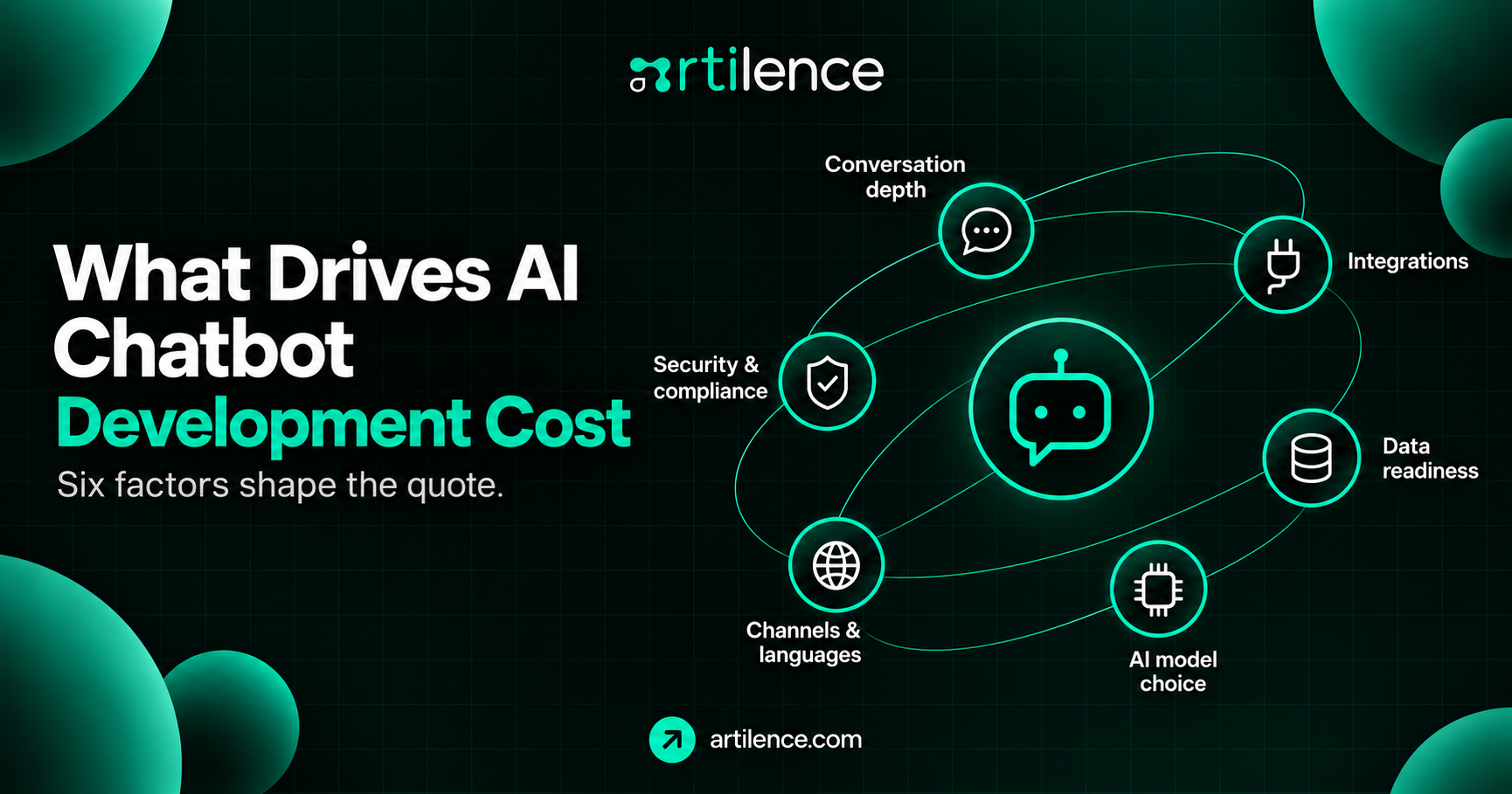
What Drives AI Chatbot Development Cost
Seven factors explain most of the difference between a low quote and a high one.
1. Conversation depth
A bot that answers ten questions is cheap. In contrast, a bot that handles hundreds of topics, follow-ups, and edge cases needs far more design and testing. In fact, depth alone can change the price several times over.
2. Integrations
Every connected system adds work. First, your team must map the data. Next, engineers build and secure the connection. Finally, they test what happens when that system is slow or down. For example, CRM, EHR, payment, and ticketing tools are the usual cost drivers.
3. Data readiness
AI is only as good as the data behind it. If your help articles are outdated or scattered, someone must clean them first. For that reason, data preparation is often a larger line item than the model itself.
4. AI model choice
Hosted models cost less to start. However, custom or fine-tuned models cost more, but they can improve accuracy in a narrow field. Meanwhile, every model has a running cost per conversation, so volume matters.
5. Channels and languages
A web chat widget is the simplest option. In contrast, WhatsApp, voice, mobile apps, and several languages each add design, testing, and upkeep.
6. Security and compliance
Regulated work costs more because it must be provable. A chatbot that touches patient data must follow HIPAA rules. Likewise, a finance bot may need audit trails and payment-grade protection. You can read more in our plain guide to a HIPAA compliant chatbot.
7. Team model and location
Who builds the bot matters as much as what they build. A senior team costs more per hour but often needs fewer rounds of rework. In contrast, a cheap team that misses the brief can double your total spend.
Hidden Costs That Add to AI Chatbot Development Cost
However, the build is not the end of the budget. Therefore, plan for these ongoing items from day one.
- Hosting and model usage. Each conversation uses compute. Costs grow with traffic.
- Maintenance. Many vendors suggest budgeting roughly 15% to 20% of the build cost each year for fixes, updates, and monitoring.
- Content updates. When your prices, policies, or products change, the bot must change too.
- Quality review. Someone should read real conversations every month and fix weak answers.
- Human handoff. A good bot passes hard cases to a person. That person needs time and tools.
As a result, a $60,000 build can easily mean $10,000 or more per year to keep it sharp.
AI Chatbot Development Cost in Healthcare and Finance
Regulated industries pay a premium, and for good reason. A mistake here is not just a bad answer. Instead, it can be a data breach or a compliance failure.
In healthcare, a chatbot may need a Business Associate Agreement, access controls, and logging for any protected health information. It may also connect to an EHR through standards such as HL7 and FHIR. Those integrations take careful design and testing. If you work in this field, see our healthcare chatbot development service for how we approach it.
In finance, bots often support fraud checks, KYC and AML steps, and payment flows. Therefore, they need strong audit trails and strict data handling from the first sprint.
The takeaway is simple. Do not compare a regulated build with a generic website bot. The safeguards are the product.
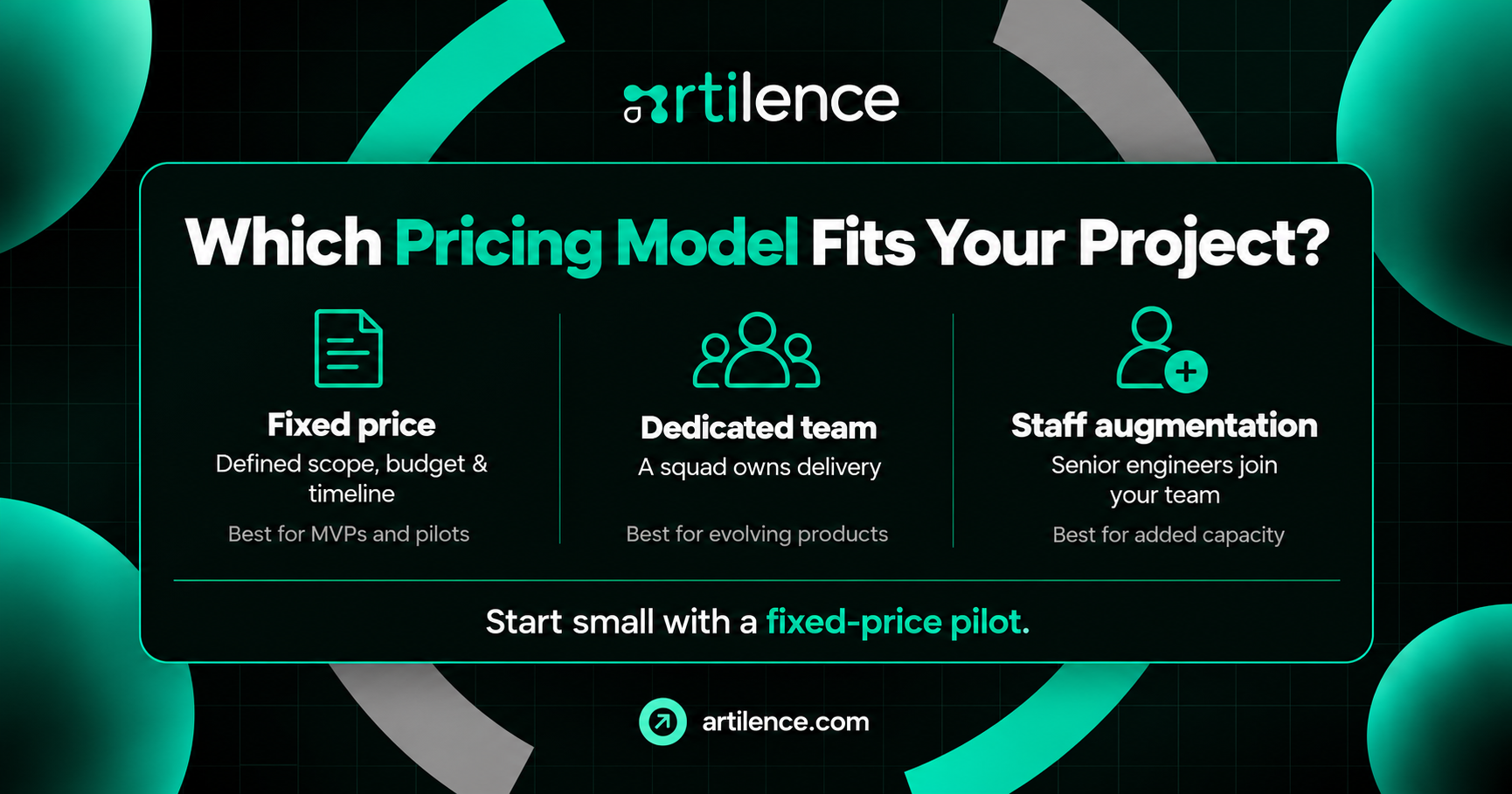
Which Pricing Model Fits Your Project?
How you pay changes both your risk and your flexibility. At Artilence, we offer three engagement models.
- Fixed price. You agree on scope, budget, and timeline up front. This suits MVPs, pilots, and proofs of concept.
- Dedicated team. A cross-functional squad owns delivery from discovery to production support. This suits larger or evolving products.
- Staff augmentation. Senior engineers join your team and work in your tools. This suits teams that already have a roadmap and need more capacity. You can learn more on our staff augmentation page.
If you are unsure, start with a fixed-price pilot. As a result, it limits your spend and shows real results quickly.
How to Lower AI Chatbot Development Cost Without Cutting Quality
You do not need to give up quality to save money. Instead, spend smarter.
- Start with one use case. First, pick the single task that saves the most time, such as appointment booking or order status.
- Ship a small first version. Next, launch to a limited group, then learn from real chats.
- Reuse proven parts. Then use hosted models and existing components to cut build time.
- Clean your content early. Also, good source material improves answers and reduces rework.
- Add features in phases. Therefore, each release should earn its next budget.
- Measure from day one. Finally, track resolution rate, handoff rate, and time saved so you can prove return.
This approach is the opposite of a big-bang launch. In fact, it is how most successful bots begin.
Common Budgeting Mistakes
Teams often inflate their AI chatbot development cost for the same few reasons.
- Choosing on price alone. However, the lowest quote often leaves out testing, security, or handoff.
- Skipping discovery. As a result, scope grows mid-project and costs rise.
- Ignoring running costs. The launch is only the start.
- Building too much at once. Also, big scopes hide risk until it is expensive to fix.
- Forgetting a human fallback. Customers get frustrated when the bot has no exit.
If you are hiring outside help, our guide on how to hire chatbot developers in the USA includes a red-flag checklist you can use before you sign.
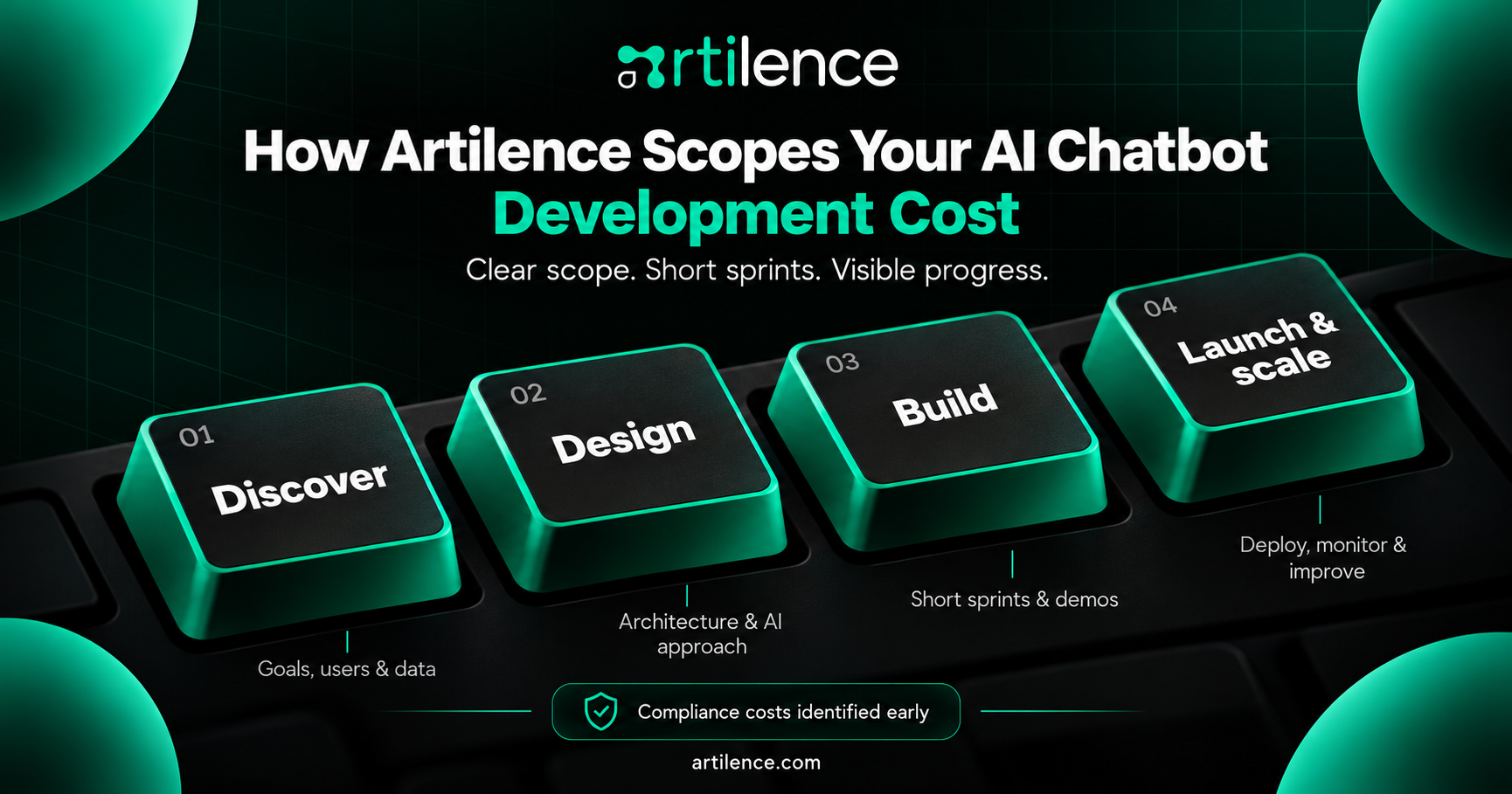
How Artilence Scopes Your AI Chatbot Development Cost
We build AI agents, chatbots, and software for startups and enterprises, and we have delivered 100+ AI solutions. Our senior engineers ship in short sprints, so you see working software every week or two. As a result, your budget is tied to visible progress, not promises.
Here is how a project runs with us.
- Discover. First, we map your goals, users, data, and limits, and agree on what success means.
- Design. Next, we plan the architecture, user experience, and AI approach together, so the product is secure and scalable from day one.
- Build. Then our engineers ship in short sprints with regular demos.
- Launch and scale. Finally, we deploy, monitor, and keep improving, and we can stay on as your long-term engineering partner.
In addition, we specialize in regulated work. For healthcare, that includes HIPAA-aligned design and HL7 and FHIR integration. For finance, it includes fraud, KYC, and AML automation. Because of this experience, we can flag compliance costs early instead of surprising you later.
Want to see proof first? Browse our case studies to see how we built real products with our clients.
Frequently Asked Questions
How much does it cost to build an AI chatbot?
Most projects fall between $3,000 and $500,000 or more. Simple rule-based bots sit at the low end. In contrast, enterprise AI agents that act across several systems sit at the high end.
How long does it take to build an AI chatbot?
A simple bot can take a few weeks. However, a generative AI chatbot usually takes three to five months. Finally, an enterprise agent can take four to nine months, depending on integrations and compliance.
What is the ongoing cost of an AI chatbot?
Expect hosting, model usage, content updates, and monitoring. Many teams budget around 15% to 20% of the build cost each year for upkeep.
Can I start with a small pilot?
Yes. A fixed-price pilot is often the best first step. It proves value, limits risk, and shows you what to build next.
Why do healthcare and finance chatbots cost more?
They must protect sensitive data and prove compliance. For example, features such as audit trails, access controls, and secure integrations add design, testing, and review time.
Get a Realistic Plan and Budget for Your Chatbot
Every project is different, so the best AI chatbot development cost estimate comes from your own scope. Tell us what you want to build. We will review your idea, suggest the right AI approach, and outline a realistic plan and budget.
Artilence Newsletter
Don't worry your email is secure with us, We will use it to share the latest updates straight to your inbox!
By subscribing, you agree to our Privacy Policy.
Ready to Build Something Great?
Book a free strategy call with our team and let's turn your idea into reality.
Related Insights



AI is our language, we speak it fluently. Let's innovate together.




Services
Artilence Newsletter
Don't worry your email is secure with us, We will use to share latest updates straight to your inbox!
By subscribing, you agree to our Privacy Policy.


