


Ready to Build Something Great?
Book a free strategy call with our team and let's turn your idea into reality.
Share This Blog
Knowing how to choose an AI development company can save you months of delay and a large part of your budget. Many vendors claim AI skills. However, only a few can ship a secure product that works in the real world. Therefore, you need a clear way to tell them apart.
This guide gives you nine questions, a red-flag checklist, and a simple method to compare vendors. In addition, it explains which engagement model fits which project. If you would rather talk it through, you can book a free consultation at the end.
Why Your Choice of AI Partner Matters
An AI project is not like buying software off the shelf. In fact, your partner shapes the data you use, the risks you take, and the speed at which you learn. As a result, a weak choice shows up late, when changes are expensive.
For example, a vendor may deliver a great demo but skip security, testing, or a plan for after launch. Consequently, the product works on stage and fails with real users. Knowing how to choose an AI development company prevents that gap.
Step 1: Define What You Need First
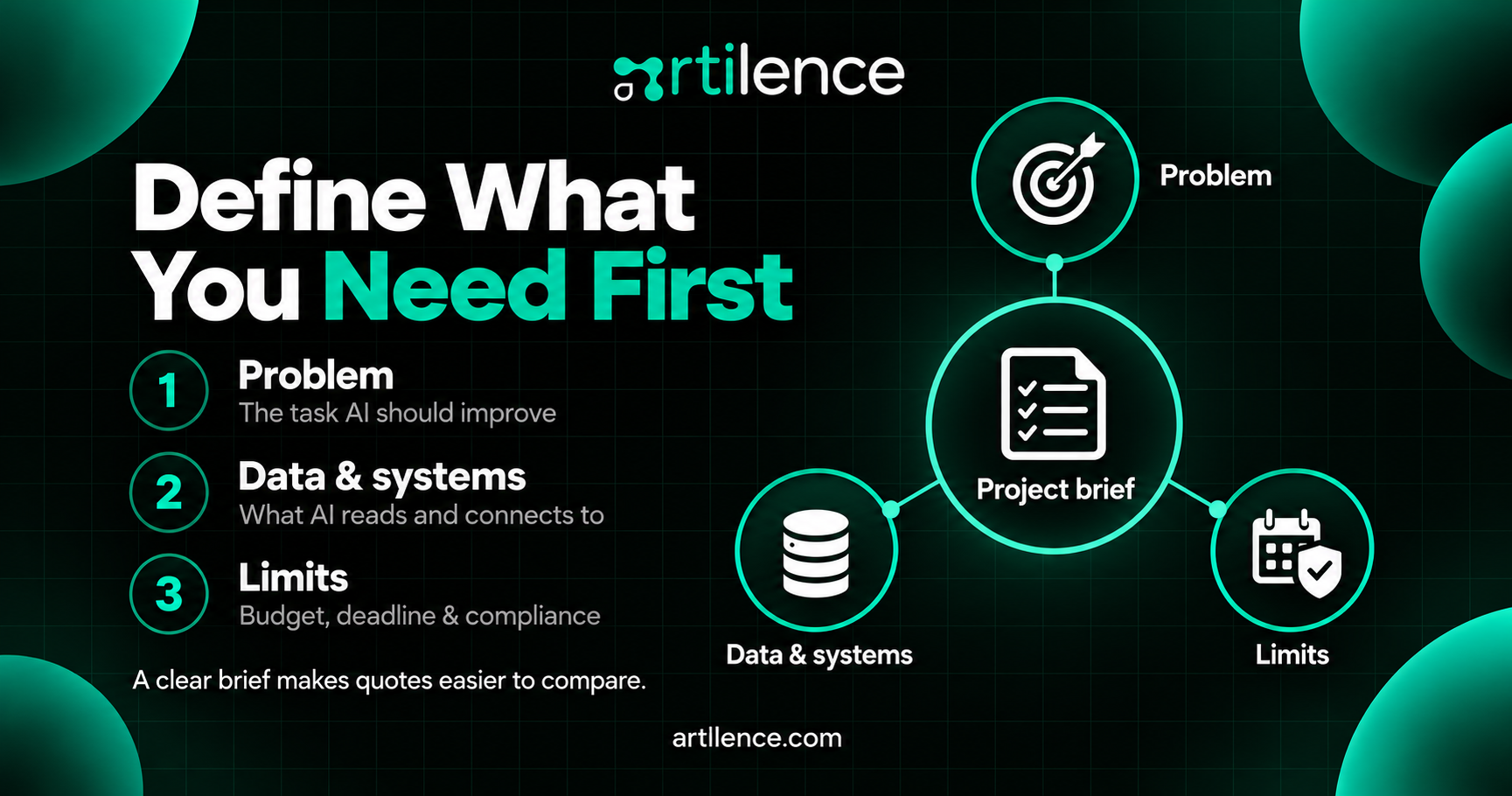
Before you talk to any vendor, write down three things.
- The problem. First, state the task you want AI to improve, such as booking visits or answering support tickets.
- The data and systems. Next, list what the AI must read or connect to, such as a CRM, an EHR, or a help center.
- The limits. Finally, note your budget range, deadline, and any rules you must follow, such as HIPAA or PCI DSS.
A short brief like this simplifies how to choose an AI development company, because every quote becomes easier to compare. In addition, it shows vendors that you are serious, which usually brings better answers.
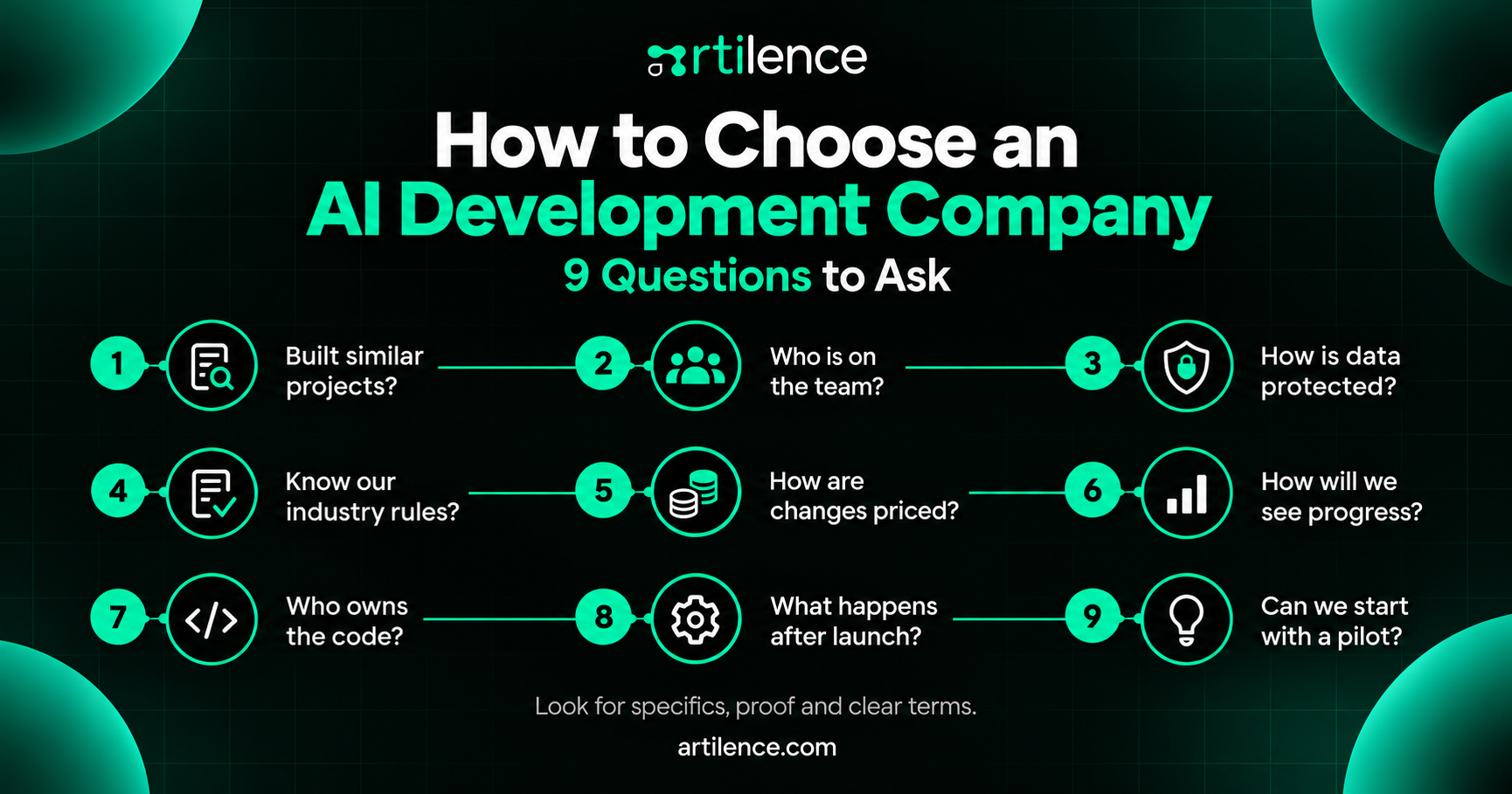
How to Choose an AI Development Company: 9 Questions to Ask
Use these questions in every vendor call. Notice how a strong partner answers with specifics, while a weak one answers with buzzwords.
1. Have you built something like this before?
Ask for case studies in your industry or with a similar workflow. Also, ask to speak with a past client.
- Good answer: a named project, a clear result, and a reference you can call.
- Red flag: vague claims, no examples, or only demos.
For example, you can see how we answer this on our case studies page.
2. Who will actually work on my project?
Sales teams often send senior people to the pitch and junior people to the build. For that reason, ask for the real team, their roles, and their experience.
- Good answer: named engineers, defined roles, and a senior lead who stays on the project.
- Red flag: "We will assign the team after you sign."
3. How do you protect my data?
AI projects often touch private data. Therefore, ask where data is stored, who can see it, and how it is deleted.
- Good answer: access controls, encryption, audit logs, and a clear data-handling policy.
- Red flag: no written answer, or "that is standard."
4. Do you have experience with my industry's rules?
Regulated work needs proof, not promises. For example, in healthcare, that may mean HIPAA and a Business Associate Agreement. Likewise, in finance, it may mean PCI DSS, KYC, and AML controls.
- Good answer: specific rules named, with examples of how they were built into past projects.
- Red flag: "We can add compliance later."
5. How do you scope, price, and handle changes?
Surprise costs are the most common complaint in outsourced projects. Instead of guessing, ask how the vendor estimates work and what happens when the scope changes.
- Good answer: a written scope, a clear price model, and a change process everyone agrees on.
- Red flag: a very low quote with no breakdown.
In addition, for a deeper look at budgets, read our guide to AI chatbot development cost.
6. How will I see progress?
You should never wait months to see working software. In fact, regular demos are one of the best signs of a healthy project.
- Good answer: short sprints, a demo every one or two weeks, and direct access to the team.
- Red flag: one big reveal at the end.
7. Who owns the code and the models?
Ownership should be clear in the contract. Otherwise, you may pay for a product you cannot fully control.
- Good answer: you own the code, the data, and the custom work, and the contract says so.
- Red flag: unclear terms or heavy lock-in.
8. What happens after launch?
An AI product needs monitoring, updates, and quality review. Meanwhile, models and data change over time, so a launch is only the start.
- Good answer: a support plan, monitoring, and a path for improvements.
- Red flag: "We hand over the code and we are done."
9. Can we start with a small pilot?
A pilot limits risk and shows how the team works. Likewise, it gives you real results before you commit to a larger budget.
- Good answer: a scoped pilot with clear success measures and a fixed timeline.
- Red flag: pressure to sign a large contract first.
How to Choose an AI Development Company: 9 Questions to Ask
Strong Signals vs Weak Signals
Here is how to choose an AI development company at a glance: compare vendors side by side.
| Area | Strong signal | Weak signal |
| Proof | Named case studies and reachable references | Logos with no stories |
| Team | Senior engineers on your project | A different team after signing |
| Security | Written data and access policies | "We take security seriously" |
| Compliance | Past work under your regulations | Compliance as an add-on |
| Pricing | Clear scope and change process | Low quote, no detail |
| Delivery | Demos every one or two weeks | A single final reveal |
| Ownership | You own code and data | Unclear contract terms |
| After launch | Monitoring and support plan | Handover only |
Which Engagement Model Fits Your Project?
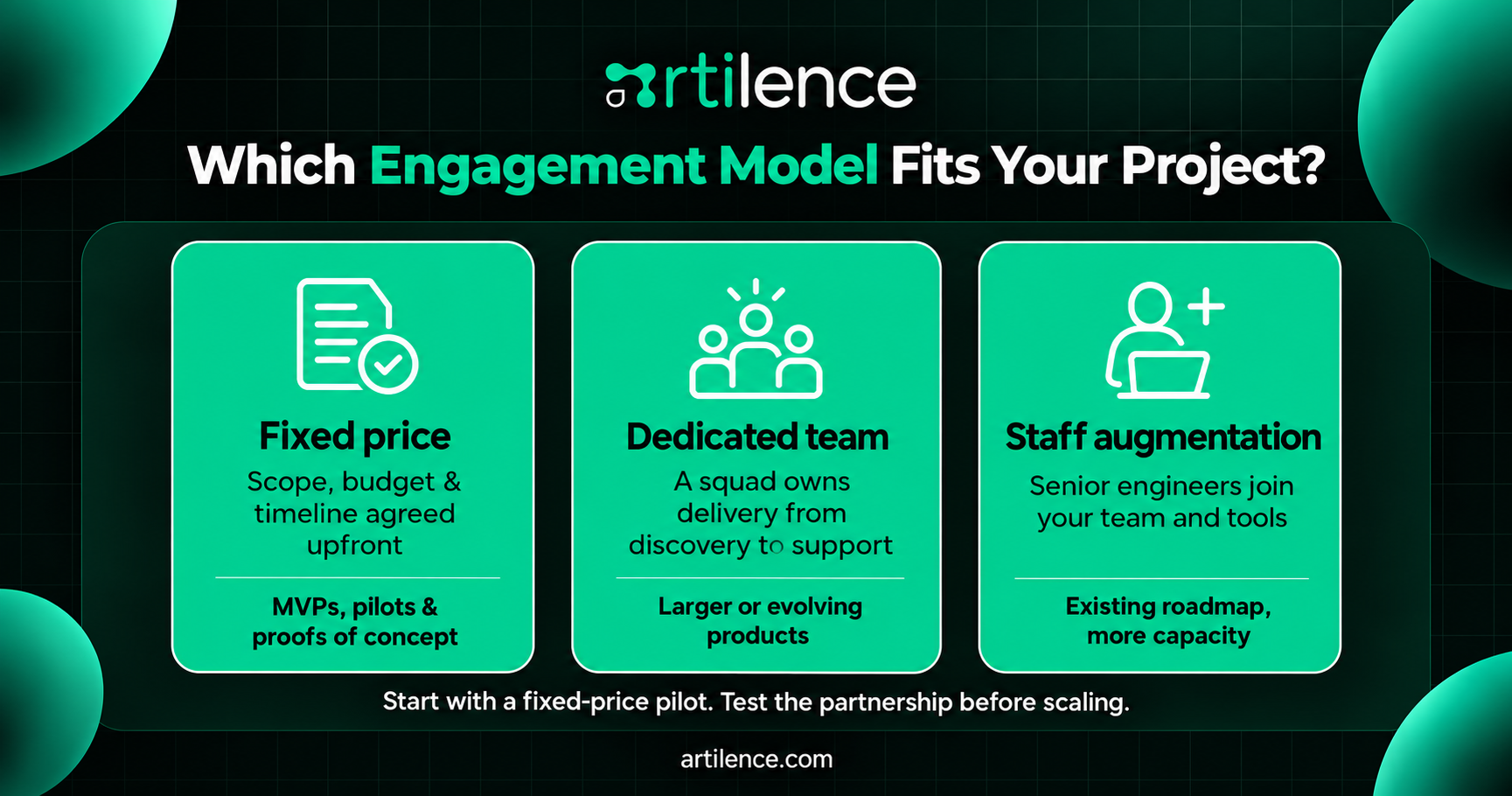
When you plan how to choose an AI development company, remember that how you work with a vendor matters as much as who you pick. Most AI partners offer three models.
- Fixed price. You agree on scope, budget, and timeline up front. For example, this suits MVPs, pilots, and proofs of concept.
- Dedicated team. A cross-functional squad owns delivery from discovery to production support. In contrast, this suits larger or evolving products.
- Staff augmentation. Senior engineers join your team and use your tools. Likewise, this suits teams that already have a roadmap and need more capacity. Learn more about our staff augmentation service.
If you are unsure, start with a fixed-price pilot. As a result, you test the partnership before you scale it.
Red Flags to Avoid
As you work out how to choose an AI development company, walk away or ask harder questions if you see any of these.
- Guaranteed results. AI work involves testing, so honest vendors talk about measures, not guarantees.
- No questions for you. Instead, a good partner asks about your users, data, and goals before quoting.
- Pressure to decide fast. In contrast, strong vendors let you compare options.
- Buzzword-heavy answers. Also, specific answers show real experience.
- No plan for failure. Ask what happens if the first approach does not work.
How to Choose an AI Development Company in 4 Steps
Put everything together with this simple process.
- Shortlist three vendors. First, pick partners with proof in your industry.
- Send the same brief to each. Next, compare their questions, scope, and price on equal terms.
- Run the nine questions. Then score each answer from one to five using the table above.
- Test with a pilot and check references. Finally, start small, and call at least one past client before you commit.
The takeaway is simple. The best vendor is not the cheapest or the loudest. It is the one that gives clear answers, shows real work, and protects you if things change.
How Artilence Answers These Questions
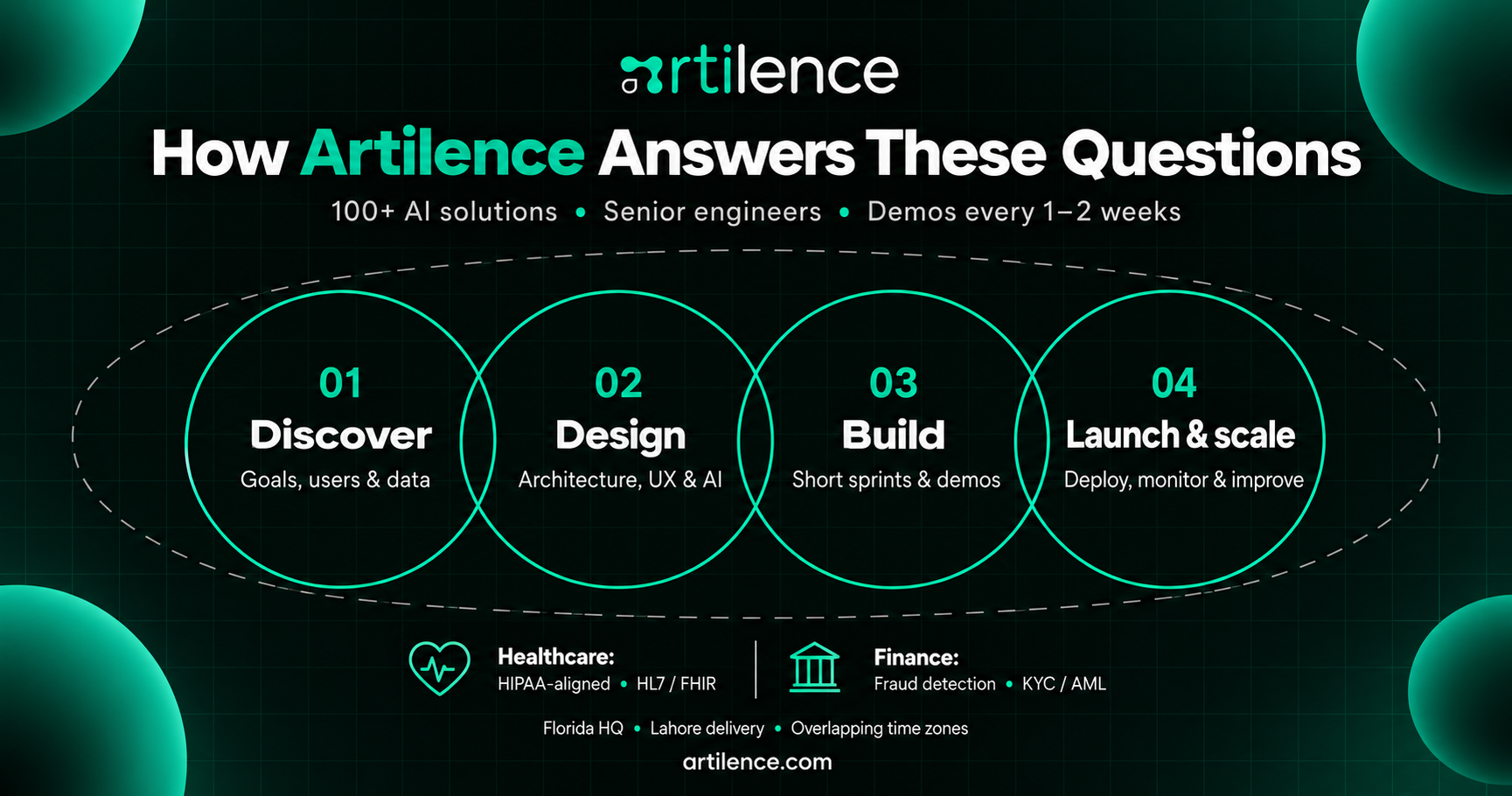
We build AI agents, chatbots, and software for startups and enterprises, and we have delivered 100+ AI solutions. Our senior engineers ship in short sprints, so you see working software every week or two. In addition, we work in time zones that overlap with yours, with our headquarters in Florida and a delivery center in Lahore.
Here is how a project runs with us.
- Discover. First, we map your goals, users, data, and limits, and agree on what success means.
- Design. Next, we plan the architecture, user experience, and AI approach together, so the product is secure and scalable from day one.
- Build. Then our engineers ship in short sprints with regular demos.
- Launch and scale. Finally, we deploy, monitor, and keep improving, and we can stay on as your long-term engineering partner.
In addition, we build for regulated industries. For healthcare, that includes healthcare AI development with HIPAA-aligned design and HL7 and FHIR integration. For finance, it includes fintech AI development such as fraud detection and KYC and AML automation. Because of this experience, we can raise compliance questions early instead of surprising you later.
Want to compare us against your shortlist? Browse our reviews and AI development services, then ask us the nine questions above.
Frequently Asked Questions
How do I choose an AI development company for my business?
First, start with a clear brief, then compare three vendors on proof, team, security, pricing, and support. Finally, run a small pilot before you commit to a large project.
What should I look for in an AI development company?
Look for relevant case studies, senior engineers, clear data protection, experience with your industry's rules, and regular demos. In addition, check that you will own the code and data.
How much does it cost to hire an AI development company?
Costs depend on scope, integrations, and compliance needs. However, a written scope and a clear change process matter more than the lowest quote.
Should I start with a pilot?
Yes. A pilot limits risk, shows how the team works, and gives you real results to guide the next phase.
How long does it take to build an AI product?
A focused pilot can take weeks, while a full product can take several months. Therefore, ask each vendor for a timeline tied to specific milestones.
Need Help Deciding How to Choose an AI Development Company?
Every project is different, so the best way to judge a partner is to talk to them. Tell us what you want to build. We will review your idea, suggest the right AI approach, and outline a realistic plan and budget.
Artilence Newsletter
Don't worry your email is secure with us, We will use it to share the latest updates straight to your inbox!
By subscribing, you agree to our Privacy Policy.
Ready to Build Something Great?
Book a free strategy call with our team and let's turn your idea into reality.
Related Insights



AI is our language, we speak it fluently. Let's innovate together.




Services
Artilence Newsletter
Don't worry your email is secure with us, We will use to share latest updates straight to your inbox!
By subscribing, you agree to our Privacy Policy.


