


Ready to Build Something Great?
Book a free strategy call with our team and let's turn your idea into reality.
Share This Blog
Your phone buzzes at 9 p.m. A customer wants a quote, and another wants to reschedule. Nobody on your team is online, so both leads are gone by morning. That is why many US owners hire chatbot developers and look into chatbot development services.
However, buying a bot is not like buying a laptop. You cannot just grab one off a shelf. Instead, you must decide who builds it, what it should do, and how you will know it works. This guide gives you a clear plan in plain words. Artilence, a US-headquartered tech team, shares what we see on real projects.
Should You Hire Chatbot Developers or Build It Yourself?
Start with one honest question. Is the bot a side tool, or is it central to your sales and support?
A side tool can start on a no-code builder. You pick a template, add your answers, and paste a small snippet on your site. It is fast and cheap. However, it has limits, because you cannot link deep systems or shape how the bot thinks.
A bot that touches money, bookings, or private data is different. In that case, many owners choose to hire chatbot developers. A skilled team links the bot to your systems, tests it hard, and keeps it safe.
Here is a quick test. Count how many of these are true for you:
- The bot must read or change data in your CRM or booking tool.
- Customers will share personal details in the chat, so privacy matters.
- You need the bot to speak more than one language.
- A wrong answer could cost you money or trust.
- You want the bot to grow along with your business.
If you answered "yes" once or never, try a no-code tool first. If you answered two or three times, talk to an agency. Four or five? Then you need a full team and a clear plan.
Five Signs It Is Time to Hire Chatbot Developers
Timing matters, because a bot works best when real pain already exists. Look for these signs:
- Your team answers the same ten questions every day.
- Customers write to you after office hours.
- Leads go cold because replies come too late.
- Staff lose hours on forms that a tool could fill.
- You already have written answers, like FAQs or price sheets.
The last sign matters most, since a bot is only as good as what it knows. So if your best answers live in one person's head, write them down first. Then the bot has something to learn from.
Three or more signs? Then the timing is good to hire chatbot developers. If you see none at all, wait. A bot cannot fix a problem you do not have.
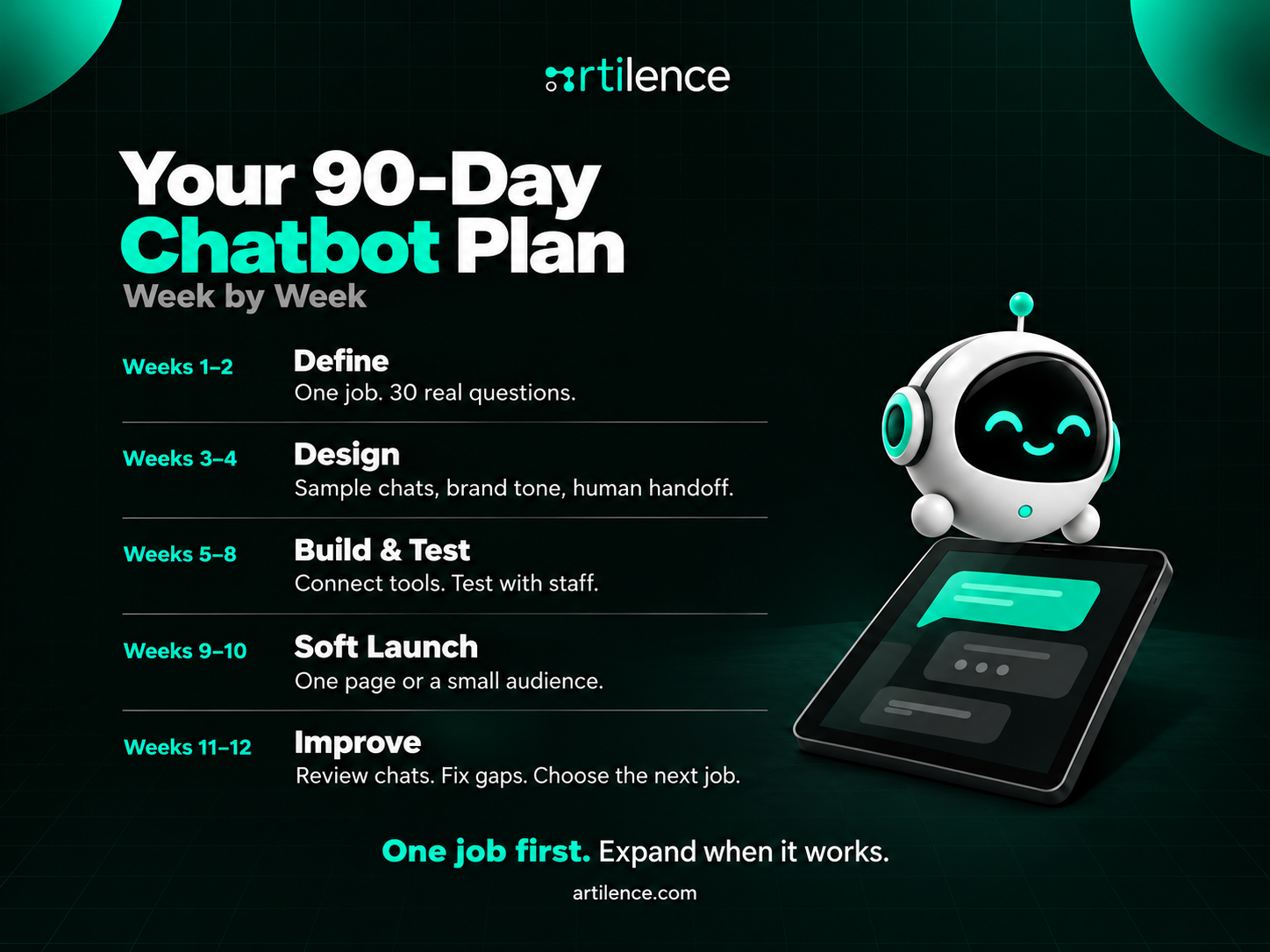
Your 90-Day Plan, Week by Week
Most simple bots can go live in less than 90 days. Still, this frame leaves room to learn. Here is a map that chatbot development services teams often follow.
- Weeks 1 and 2: pick one job for the bot. Then collect 30 real questions from emails, calls, and chats.
- Weeks 3 and 4: write sample chats. Also choose a tone that fits your brand and set clear rules for when a person takes over.
- Weeks 5 to 8: build the bot and connect it to your tools. Meanwhile, your staff tests it and tries to break it.
- Weeks 9 and 10: launch softly. For example, show the bot on one page or to a small share of visitors.
- Weeks 11 and 12: read the chats, fix the gaps, and pick the next job.
Notice what is missing. Nobody builds ten features at once. Instead, one job comes first, and the rest follow when the first one works.
Do the Math Before You Hire Chatbot Developers
A bot is a business choice, so check the numbers. Here is a simple example, but use your own figures instead.
Say your team gets 600 chats a month. Each chat takes six minutes, so that adds up to 60 hours of work. If a bot solves half of them alone, you save 30 hours. At $25 an hour, that is $750 a month.
Now add leads. Imagine the bot catches ten extra leads after hours. If you close two of them at $500 each, that brings in $1,000 more. Together, the gain is $1,750 a month.
Next, compare that gain to the quote and the monthly fee. If the bot pays for itself within a year, the plan is strong. However, if it takes much longer, shrink the scope. A smaller first bot often fixes the math.
Homework to Finish Before the First Call
Good quotes start with good prep, so bring these five things to your first meeting:
- A list of your top 30 customer questions.
- Your best written answer to each one.
- A list of the tools the bot must connect to.
- One person at your company who owns the bot.
- A number that defines success, such as "40 percent of chats solved alone."
Also write down what the bot must never do. For example, it should not promise refunds, give legal advice, or share unapproved prices. These rules protect your brand.
Teams that bring this homework get sharper quotes. Because of that, the chatbot development agency spends less time guessing. As a result, you spend less on surprises.
Red Flags to Spot Before You Hire Chatbot Developers
Not every proposal is honest, so watch for these warning signs:
- A price shows up with no list of what is included.
- No testing step appears in the plan.
- Handoff to a human gets skipped.
- A promise of 100 percent accuracy is made.
- Ownership of your chat data stays with the firm.
- Nothing is planned for after launch.
Treat the accuracy promise as a loud alarm. No bot is perfect, and honest teams say so. A good chatbot development agency explains how it catches and fixes mistakes. It also shows sample reports before you sign, which helps you hire chatbot developers with confidence.
Bots for Smaller Teams: Law Offices, Insurers, Home Repair and Restaurants
Big brands get the headlines. Yet smaller US teams gain a lot too.
- Law offices: the bot gathers case details and books consults, but it never gives legal advice.
- Insurance agencies: the bot starts quote requests and answers policy basics.
- Home repair firms: the bot asks for the address and a photo, then books a visit.
- Restaurants: the bot takes table requests and shares the menu. It also passes diet questions to staff.
In each case, chatbot integration decides success. A bot that cannot see your calendar or CRM can only chat. With a proper link, however, it can book, log, and follow up. This is where conversational AI services earn their keep, because the AI understands the message and the integration does the work.
Prepare Your Staff for the New Coworker
A bot changes daily habits, so talk to your team early. Explain that the bot takes the boring work, not their jobs. Then show them how the handoff works.
Give staff an easy way to flag wrong answers. A single button is enough. Also, reward the person who finds the most gaps each month, because their feedback is gold.
Finally, hold a short weekly review in the first quarter. Read ten chats together, and fix what you find. Small habits like this keep the bot sharp, even after you hire chatbot developers to build it.
What the First Month After Launch Should Look Like
Launch day is only the start. The first month shows what customers really ask, so plan time for it.
In week one, check the chats daily. Look for questions the bot missed. Next, add those answers and test them. By week three, you should see which topics the bot handles well. Then you can trust it with more.
At the end of the month, review the numbers with your partner. Ask how many chats the bot solved alone. Also ask how many went to a person and why. Finally, agree on one new goal for month two. Steady steps beat big leaps.
Where Artilence Fits In
Artilence is a US-headquartered team that builds AI tools, automations, and software. As a chatbot development agency, we begin with the homework call above. We ask what hurts today. Then we size the bot to fit.
We offer conversational AI services for websites, apps, and messaging tools. We also handle chatbot integration with CRMs, calendars, and help desks. Since we build automations too, your bot can trigger tasks across your whole stack. Our approach includes a small pilot, a human handoff, and monthly chat reviews.
If you plan to hire chatbot developers, ask any team for a pilot first. It shows how they work before you commit.
Your Next Step
Pick one task. Then write down your 30 questions and share them with a partner you trust. In one call, you will learn if a bot fits and what it may cost.
Whether you build in-house or hire chatbot developers, a small start wins. So reach out to Artilence, and we will walk you through chatbot development services in plain words.
Frequently Asked Questions
Is it worth it to hire chatbot developers for a small business?
Yes, if your team answers the same questions all day. A bot can cover after-hours chats, and it also saves staff time. If you hire chatbot developers, do the math first so the numbers back up your choice.
Should I use a no-code builder or hire chatbot developers?
No-code tools suit simple jobs, like store hours or basic lead forms. However, custom work fits bots that link to your CRM or handle private data. So start small, and move to custom work when you hit the limits.
Can a chatbot book appointments and take payments?
Yes, if it is linked to your calendar and payment tool. That link is called chatbot integration. Because payments need extra care, use trusted and secure payment services.
What data should I share when I hire chatbot developers?
Gather your FAQs, price sheets, policies, and past support chats. Before sharing, remove private details, like phone numbers. Clean and current answers also lead to better replies.
How accurate are chatbots?
It depends on the bot and the data behind it. Narrow bots with good content do well on routine questions. Still, no bot is perfect, so test often and keep a human backup.
What happens when a chatbot does not know the answer?
A well-built bot admits it. Then it offers to pass the chat to a person or take a message. Without this step, customers get stuck, and they leave.
Is ChatGPT the same as a custom business chatbot?
- ChatGPT is a general tool, so it does not know your prices, rules, or customers. In contrast, a custom bot is tied to your own content and tools. It also follows your brand voice and limits.
What is the difference between a chatbot and a virtual assistant?
A chatbot usually handles one job, like support or booking, inside your site or app. A virtual assistant, on the other hand, is broader and may handle many tasks across apps. Since some conversational AI services blur the line, ask each firm what it means.
Do I need to tell customers they are talking to a bot?
Yes, it is a smart habit, and some US states require it. Honest labels also build trust. This is general information, not legal advice, so check the rules for your state.
Do customers like talking to chatbots?
Many do, when tasks are quick and simple. They want fast answers at any hour. However, for tricky issues, most people still prefer a real person, so offer both.
Artilence Newsletter
Don't worry your email is secure with us, We will use it to share the latest updates straight to your inbox!
By subscribing, you agree to our Privacy Policy.
Ready to Build Something Great?
Book a free strategy call with our team and let's turn your idea into reality.
Related Insights



AI is our language, we speak it fluently. Let's innovate together.




Services
Artilence Newsletter
Don't worry your email is secure with us, We will use to share latest updates straight to your inbox!
By subscribing, you agree to our Privacy Policy.


