


Ready to Build Something Great?
Book a free strategy call with our team and let's turn your idea into reality.
Share This Blog
Most lists name the hardest coding language and stop there. That tells you almost nothing. You still do not know what it feels like to sit down and use it.
So let's try something different. We will spend one imaginary hour with each language. You will see the real code. You will also see the real error messages that make beginners groan.
By the end, you can judge the hardest coding language for yourself.
The Hello Test: One Word, Three Languages
First, our test is tiny. Make the computer say "Hi." That is all.
Here is the job in Python:
print("Hi")
Here it is in C:
#include <stdio.h>
int main(void) {
printf("Hi\n");
return 0;
}
And here it is in Lisp:
(print "Hi")
Python needs one line. C needs five. Lisp needs one, but the brackets already look odd. Still, the line count is only the start. The real pain shows up when something goes wrong.
If you plan to learn to code, run this test yourself on a free online editor. It takes ten minutes, and it shows you more than any review.
C: The Error That Says Almost Nothing
Now picture a small mistake. You ask C for a list of five numbers. Then you try to write a sixth.
C does not stop you. The program may run fine. Or it may end with this message:
Segmentation fault (core dumped)
That is all. Sadly, it does not name the line. It does not say what you did wrong. So you must hunt for the cause alone.
This is why many teachers call C the most difficult programming language for a first course. The language is small, yet it gives you no safety net. Besides, the bug may appear far from the real mistake. For that reason, C is often the hardest coding language to start with.
The reward is real, though. Once you fix a few of these, you understand how memory works. Few skills teach you more.
COBOL: When Column Seven Ruins Your Day
COBOL dates to 1959. Even so, banks and government offices still run it. In 2020, several US states asked for COBOL help to keep benefit systems working.
A tiny COBOL program looks like this:
IDENTIFICATION DIVISION.
PROGRAM-ID. HELLO.
PROCEDURE DIVISION.
DISPLAY "Hi".
STOP RUN.
Notice the big headings. Every program has divisions, like chapters in a book. Honestly, that is a lot of ceremony for one word.
Older COBOL also cares about columns. The first six columns are reserved, and code must start further in. Start one space too early, and the compiler complains. The mistake is almost invisible to your eyes.
So COBOL is easy to read but fussy to write. It is rarely named the hardest coding language, yet it surprises many learners. Its biggest hurdle is finding good lessons, since few schools teach it.
Prolog: Facts In, Answers Out
Prolog has no steps. You write facts and rules instead.
parent(tom, bob).
parent(bob, ann).
grandparent(X, Z) :- parent(X, Y), parent(Y, Z).
Now you ask who Tom's grandchild is:
?- grandparent(tom, Who).
Who = ann.
At first, it feels like magic. But then you ask something with no match, and Prolog just says "false." There is no hint about why.
Also, every line must end in a period. For example, a missing period after the first fact can break the whole file. The error then points to a spot that looks fine. Learners who know Python often struggle most, because they keep looking for the steps. Yet there are none. Is Prolog the hardest coding language for you? It might be, if you love steps.
Lisp: Math Class, Backwards
In school, you write 1 + 2 × 3. In Lisp, you write the sign first.
(+ 1 (* 2 3))
The answer is 7. You read from the inside out. Multiply 2 and 3 first. Then add 1.
At first, short lines are easy. However, long ones are not. For instance, ten closing brackets in a row are common, and one extra ruins the line. As a result, the error often shows up far from the typo. Good editors match brackets for you, which helps a lot. Even so, the first week feels like reading a puzzle. Some learners even vote for Lisp as the hardest coding language of all.
C++: A Typo That Fills the Screen
C++ has its own signature pain. Make one small mistake with a template, and the compiler may print pages of text. The real problem hides in the middle. Meanwhile, the fix may be a single character. Newer compilers have improved this, yet scrolling for clues is still common.
That is why people say C++ is the hardest coding language to master. It keeps adding features, so the list of traps keeps growing. Many hard programming languages share this problem.
One Mistake, Three Reactions
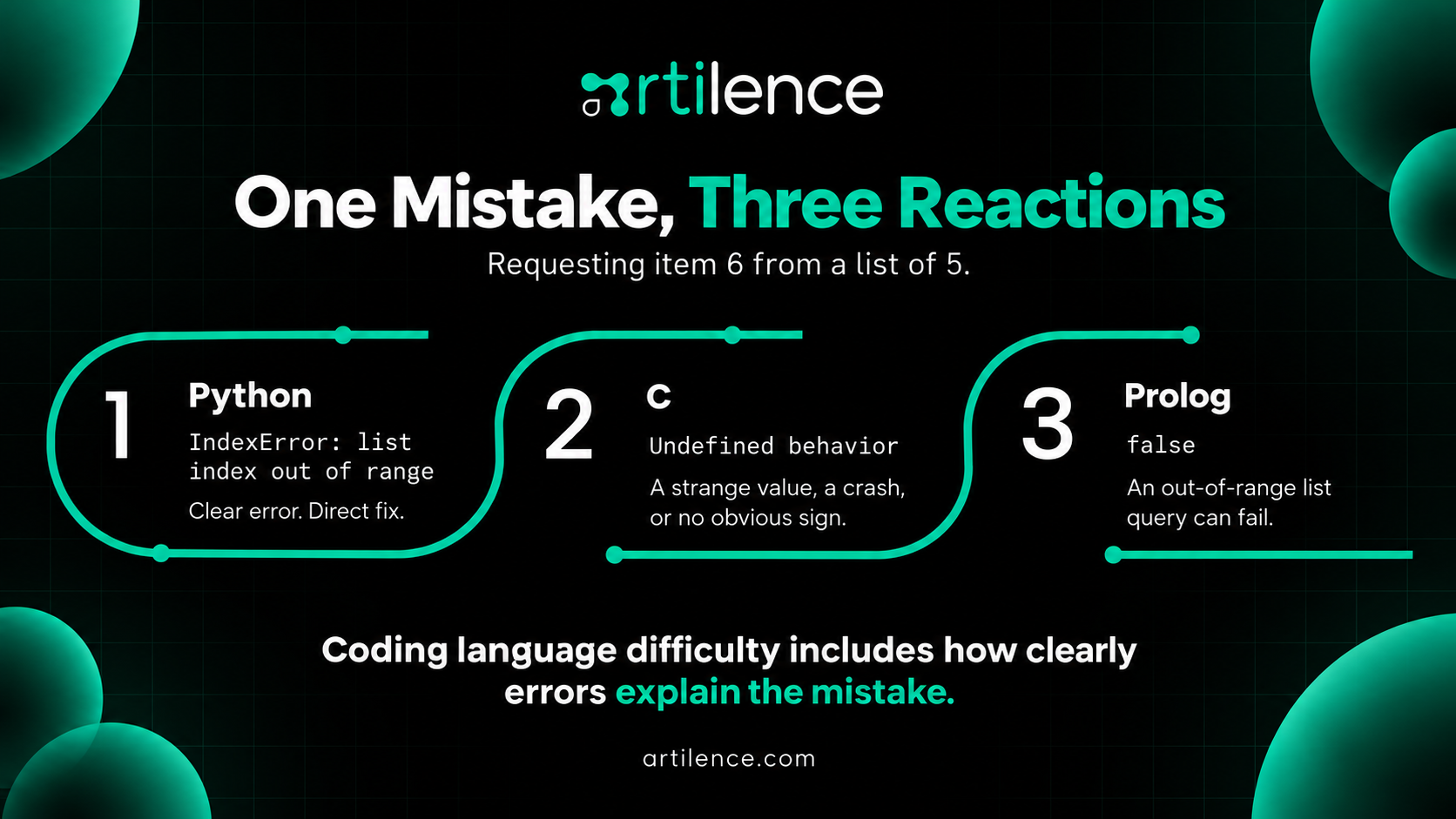
Let's run one mistake through three languages. You ask for the sixth item in a list of five.
Python stops at once. It says:
IndexError: list index out of range
That message names the problem. You fix it in a minute.
C may say nothing at all. It reads whatever sits next to your list. As a result, you get a strange number, or a crash much later.
Prolog does not crash. It simply answers "false," and you wonder why.
So the same slip costs one minute in one language and one afternoon in another. That gap is the real coding language difficulty you feel. Because the mistakes are identical, the language alone makes the difference. Therefore, a friendly error message is worth more than a short program.
Many people ask which is the most difficult programming language. Honestly, the answer depends on how much help the errors give you.
A Pain Scorecard You Can Check Yourself
Here is what we saw in our hour with each one. Use it to spot the hardest coding language for your habits.
| Language | Lines for "Hi" | First scary moment | What helps |
| Python | 1 | Rarely scary | Clear error messages |
| C | 5 | "Segmentation fault" with no hint | A debugger and tiny tests |
| COBOL | 5 | Column rules and long headings | Modern tools such as GnuCOBOL |
| Prolog | Not step-based | A bare "false." | Writing tiny facts first |
| Lisp | 1 | A lost bracket | An editor that matches them |
| C++ | About 6 | Pages of errors | Building in small pieces |
Notice the pattern. Coding language difficulty is not about line count. Instead, it is about how helpful the error is when you slip.
So Which Is the Hardest Coding Language for You?
Think about your own habits. Then match them to the pain.
- Silent tools? C will hurt most.
- Fussy spacing rules? COBOL will hurt most.
- Thinking in steps? Prolog will hurt most.
- Trusting school math order? Lisp will hurt most.
That is why one person's hardest coding language is another person's weekend hobby. Our own pick is simple. C is hardest to start, and C++ is hardest to master.
What Hard Languages Mean for US Job Seekers
Does a tough language lead to a good job? Sometimes. But the path matters.
C and C++ appear often in device, car, and game work. COBOL jobs sit in banks, insurers, and public offices. Lisp and Prolog show up mostly in research, teaching, and special tools.
Fewer experts means less competition. Therefore, pay can be strong in niche roles. Skills in hard programming languages can also set you apart in an interview. However, fewer jobs exist, so plan for a longer search.
A smart plan mixes both. First, pick one friendly language to learn to code with confidence. Then add one hard language that fits the jobs in your city. Also check local job boards before you choose. Do not pick the hardest coding language just for pay. Real posts tell you more than any ranking.
The Honest Verdict
So, what is the hardest coding language? There is no single crown. C hurts most when you are starting out, because its errors say so little. C++ takes the prize for long-term mastery. Prolog and Lisp win for sheer weirdness.
Which is the most difficult programming language overall? Remember that coding language difficulty is personal, because it depends on what frustrates you most. Pain also shrinks with practice, so stay patient. Every expert once stared at a cold error message and felt lost.
Pick one language. Use the three habits. Build small things each week. Soon, someone will ask you about the hardest coding language. You can answer with your own story, and a few real error messages.
Quick Answers on Difficulty
Is coding hard to learn?
Coding feels hard at first, but most people get used to it. The first month is the roughest. After that, simple ideas start to repeat, and things click.
What is the hardest part of coding?
For most people, it is fixing bugs, not writing code. Finding out why something breaks takes patience. Small, frequent tests make this much easier.
Is C harder than C++?
C is smaller, but it gives you fewer safety tools. C++ is larger and has more rules to learn. Many people find C harder to start and C++ harder to master. Neither is the clear hardest coding language, because it depends on your goals.
Is Java harder than Python?
Yes, for most beginners. Java needs more setup and more words for the same task. Python is shorter and gentler, though Java builds strong habits.
Is COBOL hard to learn?
The words are easy to read, but the programs are long. The real challenge is finding good learning material. Because few schools teach it, most people learn on the job.
Quick Answers on Starting Out
Do you need to be good at math to start coding?
Not much. Basic math is enough for most web and app jobs. Fields like graphics and data science use more math later.
Is JavaScript hard to learn?
The basics are friendly. You can see results in a browser right away. Harder parts show up later, such as slow tasks and odd rules.
Can you start coding at 40?
Yes. Many people start later in life and do well. Steady practice matters more than age. Employers care most about what you can build.
How many programming languages should I learn?
Start with one and get comfortable. Then add a second to widen your view. Most coders end up using a few over the years.
Does a hard language mean a higher salary?
Not always. Pay depends on the job, the city, and demand. Niche skills can pay well, but fewer jobs exist.
Artilence Newsletter
Don't worry your email is secure with us, We will use it to share the latest updates straight to your inbox!
By subscribing, you agree to our Privacy Policy.
Ready to Build Something Great?
Book a free strategy call with our team and let's turn your idea into reality.
Related Insights



AI is our language, we speak it fluently. Let's innovate together.




Services
Artilence Newsletter
Don't worry your email is secure with us, We will use to share latest updates straight to your inbox!
By subscribing, you agree to our Privacy Policy.


