


Ready to Build Something Great?
Book a free strategy call with our team and let's turn your idea into reality.
Share This Blog
The toughest coding language is a question almost every new coder asks. You open a code editor for the first time. Then you see a wall of strange symbols. Your brain says, "Maybe this is not for me."
Almost every coder has felt that way. The good news is that the pain is normal. Also, it depends on the language you pick. Still, some languages really are harder than others.
So what is the toughest coding language for most people? Let's find out in plain words, with no confusing talk.
What Does "Hard" Even Mean in Code?
People use the word "hard" in different ways. For example, a language can be hard to read. Or it can be hard to write. In some cases, it is hard to fix when it breaks.
Here are the three things that make a language tough:
- First, it has strict rules that punish small mistakes.
- Next, it makes you manage the computer's memory by hand.
- Finally, it asks you to think in an odd, new way.
A language can have one of these traits or all three. As a result, the more traits it has, the harder it feels. That is what makes a language the toughest coding language on a list.
Think about learning to drive. An automatic car is simple. However, a manual car with no power steering takes more work. Both get you to the store. Still, one just asks more of you.
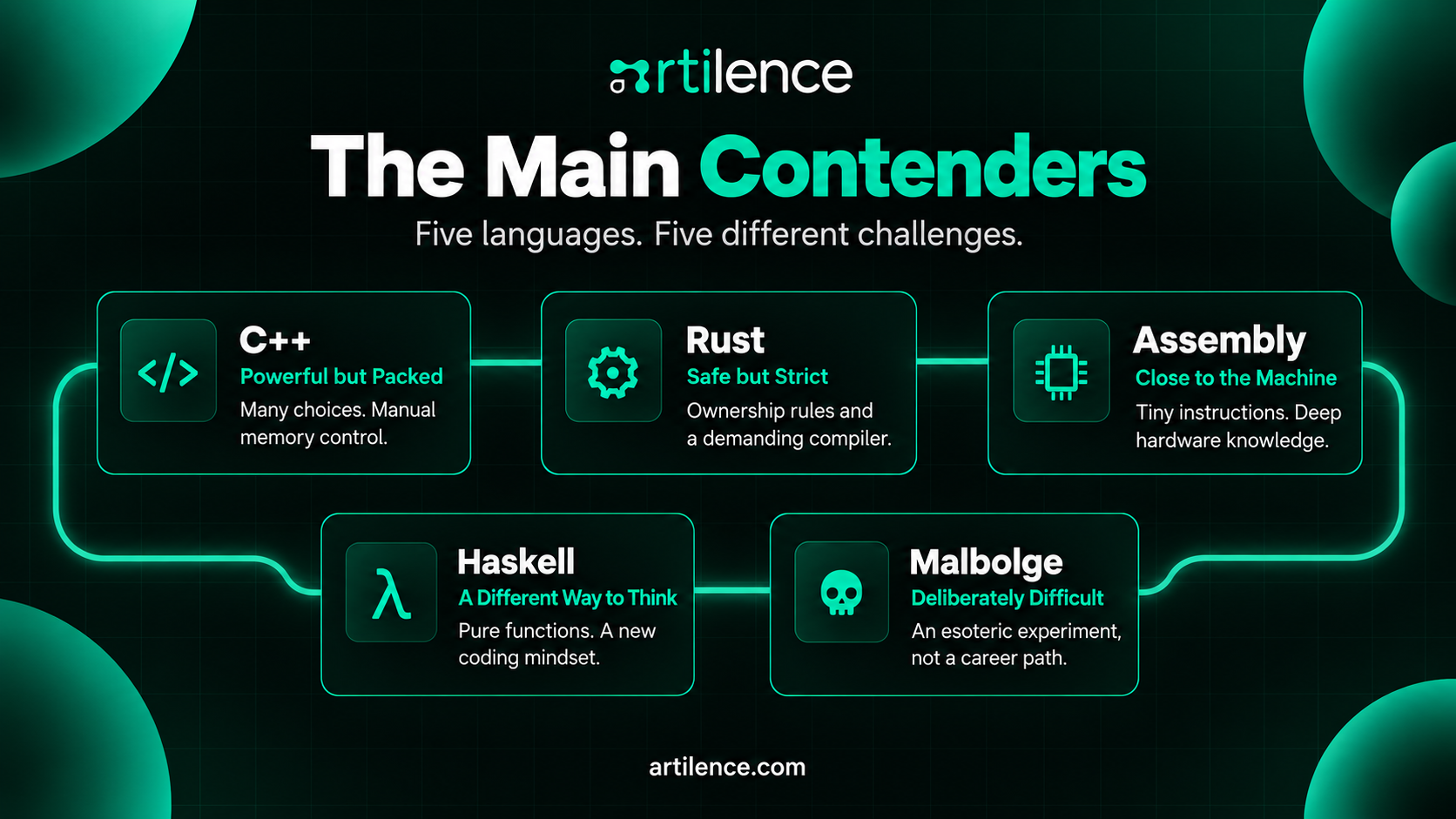
The Main Contenders
Let's meet the languages that people call the hardest programming language most often. Each one earns the label for a different reason. So each one is a fair pick for the toughest coding language title.
C++: Powerful but Packed
C++ runs games, banking tools, and car systems. It is fast. However, it is also huge.
The language has been growing for decades. Because of that, there are many ways to do one task. Beginners often feel lost in all those choices.
C++ also lets you control memory yourself. That is a big power. Yet it is also a big risk. In fact, one small slip can crash the whole program.
Rust: Safe but Strict
Rust is newer. It was built to stop memory bugs before the program even runs.
That sounds great, and it is. But the price is a very picky checker. This checker is called the compiler. It refuses to run your code until every rule is met.
Many learners say Rust feels like arguing with a strict teacher. After a few weeks, though, that teacher starts to make sense. Also, many fans say Rust makes them better coders.
Assembly: Talking Straight to the Machine
Assembly sits very close to the computer's brain. Each line does one tiny job. For example, moving a number takes one line. Adding two numbers takes another.
As a result, simple tasks need pages of code. There are no friendly helpers. Also, you must know how the hardware works.
Few people write Assembly all day. Yet it teaches you what a computer really does. Because it has so few comforts, some say it is the hardest programming language of all.
Haskell: A Different Way to Think
Haskell is a "functional" language. That means you build programs from small, pure pieces. Also, you avoid changing data once it is set.
Most beginners learn to code by giving steps in order. However, Haskell flips that habit upside down. In fact, your old instincts stop working. That is the hard part.
Malbolge: The Joke That Is Real
Malbolge was made to be nearly impossible to use. Its goal was pain. In fact, nobody builds real products with it.
It is a fun fact, not a career path. So skip it.
Which Is the Real Toughest Coding Language?
There is no single winner. Still, we can give a fair pick.
For most people, the hardest language to learn is C++ or Rust. C++ wins for its size and age. Meanwhile, Rust wins for its strict rules.
If you want pure pain, Assembly takes the crown. However, it is rare in daily work. So it is not the best test for most learners. In short, the hardest programming language for a working coder has the most rules and the fewest safety nets.
Here is a simple scorecard to make it clear:
| Language | Main Challenge | Pain Level |
| C++ | Huge size and manual memory | High |
| Rust | Strict compiler rules | High |
| Assembly | Tiny steps, no helpers | Very high |
| Haskell | New way of thinking | Medium to high |
| Python | Few real hurdles | Low |
Why Beginners Struggle So Much
The language is only part of the story. In fact, many beginners hit walls for other reasons.
First, there are too many choices. Picking a language, an editor, and a course can feel heavy. As a result, people freeze before they write one line.
Second, error messages look scary. However, red text is just a clue. It tells you where to look.
Third, many people learn without building. Watching videos feels like progress. Yet your skill grows only when you write code yourself.
Finally, people compare themselves to others. You see a stranger online build an app in a weekend. But you forget they have years of practice behind them.
These problems can make any language feel like the toughest coding language on Earth. So fix the habits first, and the language gets easier. In fact, even the hardest language to learn becomes friendlier once your routine is solid.
Easier Doors Into the Coding World
Maybe you are new. Then you do not need to start with the toughest coding language. Instead, you can begin small and grow.
The best programming language for beginners is often Python. Its code reads almost like English. For example, you can print a message in one short line. Also, you see results fast, and that keeps you motivated.
JavaScript is another smart pick. Because it runs in every web browser, you can change a web page in minutes. That is a fun way to learn.
Once you feel safe, you can move up. In fact, many pros learn Python first. Later, they add C++ or Rust. The first language trains your brain. As a result, the next ones feel less scary.
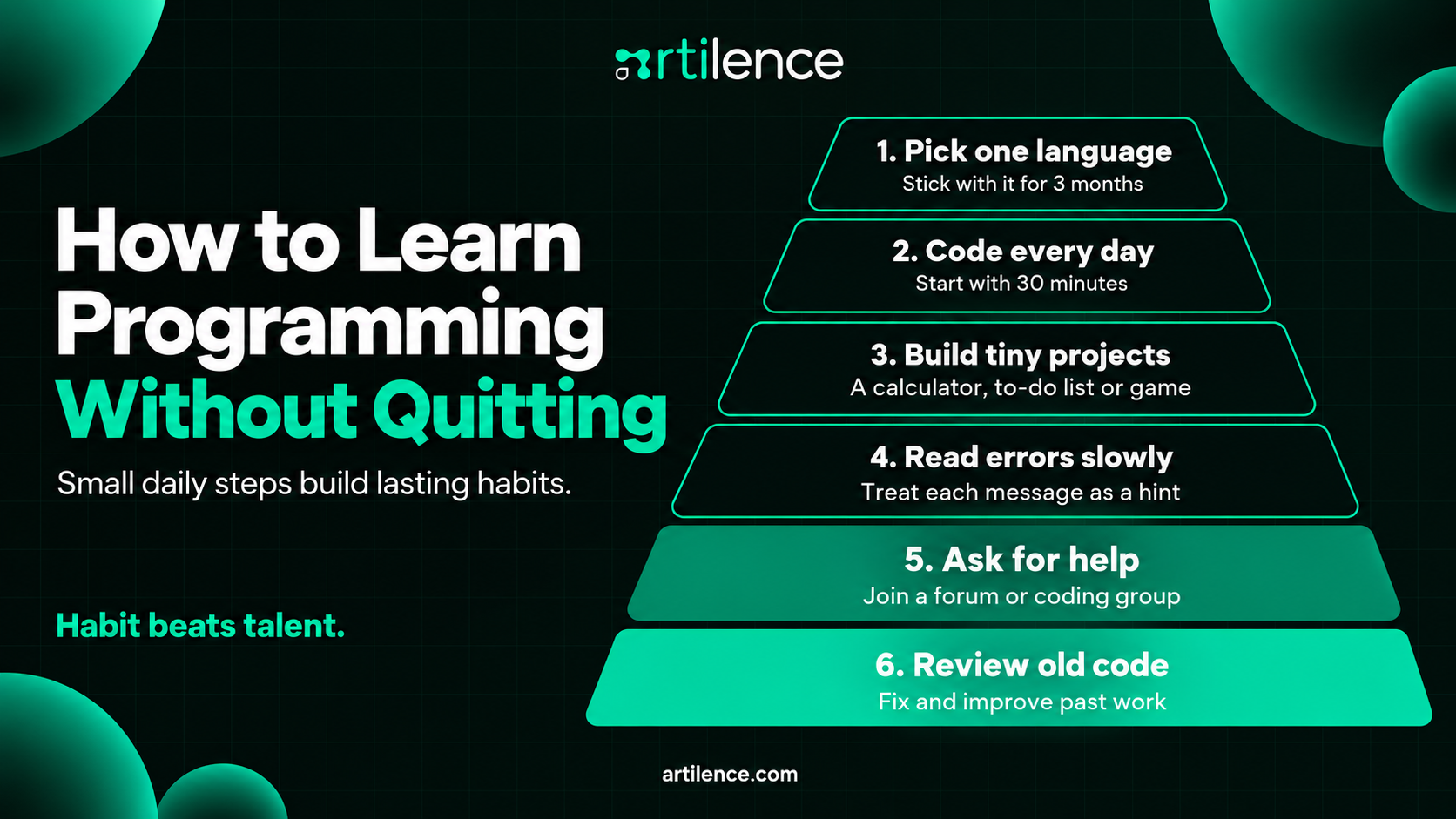
How to Learn Programming Without Quitting
Many people ask about how to learn programming the smart way. Here is a simple plan you can follow.
- First, pick one language and stay with it for three months.
- Next, code for 30 minutes a day, since small daily steps beat one long weekend.
- Then build tiny projects, like a to-do list or a simple game.
- Also, read error messages slowly and treat each one as a hint.
- After that, ask for help in a forum or a local US meetup group.
- Finally, review old code and improve what you wrote last month.
Notice that none of these steps need a genius brain. They need a habit. Indeed, habit beats talent in coding.
When a topic feels too hard, break it into tiny parts. Learn one part. Then move on. Soon the big wall becomes a set of small steps. That is the heart of how to learn programming for anyone, at any age. Also, the same plan works for the hardest language to learn.
Where Artilence Fits In
Maybe you are not a learner. Instead, you may run a business and need working software. Then the difficulty of a language is not your problem. It is ours.
Artilence is a US-based agency with delivery teams in Asia. We build AI automation tools, data systems, and full-stack apps. Also, our developers already know the tough languages. Because of that, they pick the right one for each job. We handle projects in even the toughest coding language so you do not have to.
Here is what that means for you:
- First, you get clean, fast code without the learning curve.
- Also, you get a team that explains choices in plain words.
- Finally, you get tools that save your staff hours each week.
We also help brands grow online through SEO and content. So you can build the product and get it seen in one place. If your idea needs a strong tech partner, talk to the Artilence team. Then we will help you choose the right path.
Tips for Learners in the United States
The US job market loves variety. For example, different cities lean toward different skills.
- Finance and gaming teams, for instance, often hire C++ coders.
- Also, startups love Python and JavaScript.
- Meanwhile, cloud and safety-focused firms show growing interest in Rust.
So the "hard" language you pick can shape the jobs you can chase. Also, hard skills often earn higher pay, because fewer people master them. However, a steady path matters more than a flashy one, even with the toughest coding language.
If you are just starting out, remember one thing. The best programming language for beginners is the one you will actually practice. Then stretch yourself over time.
Final Thoughts
The toughest coding language is not the same for everyone. For many, it is C++ or Rust. Others pick Assembly or Haskell. However, each one asks you to think harder and slow down.
But tough does not mean impossible. In fact, every expert was once a beginner who felt stuck. So pick the best programming language for beginners that fits you, and stay steady. Because small daily wins add up, how to learn programming gets easier each week. As a result, your first hard language makes the next one feel easy.
Frequently Asked Questions
What is the toughest coding language?
The toughest coding language for most people is C++ or Rust. C++ is huge and gives you manual control. Meanwhile, Rust has a very strict compiler.
Is C++ harder than Python?
Yes, for most people. Python is simple and reads like plain English. However, C++ asks you to handle memory and follow many rules.
Is Rust harder than C++?
It depends on the person. Rust has a steeper start because of its strict rules. Yet many say it becomes easier once the rules click. Both often top the list of the toughest coding language picks.
Which coding language is the easiest to learn?
Python is the usual pick. Its code is short and clear. Also, you see results quickly, which keeps you excited.
How long does it take to learn a hard programming language?
A basic level may take three to six months. Real skill can take a year or more. Also, daily practice makes the biggest difference.
Should a beginner start with the toughest coding language?
Most experts say no. Instead, start with Python or JavaScript first. Then move to a harder language when you feel ready.
Is Assembly still used today?
Yes, but in small areas. For example, it is used in device chips, game engines, and system tools. Still, most coders never write it daily.
Which programming language pays the most in the USA?
Pay depends on the job, the city, and your skill. Also, Rust, C++, and Go roles often pay well. Because fewer experts know them, pay can rise.
Can I learn programming without a degree?
Yes. Many US coders are self-taught or learned at bootcamps. In fact, a strong set of projects can matter more than a diploma.
How do I stay motivated when coding feels too hard?
Break each goal into tiny tasks. Also, celebrate small wins, like fixing one bug. Then join a group so you do not learn alone.
Artilence Newsletter
Don't worry your email is secure with us, We will use it to share the latest updates straight to your inbox!
By subscribing, you agree to our Privacy Policy.
Ready to Build Something Great?
Book a free strategy call with our team and let's turn your idea into reality.
Related Insights



AI is our language, we speak it fluently. Let's innovate together.




Services
Artilence Newsletter
Don't worry your email is secure with us, We will use to share latest updates straight to your inbox!
By subscribing, you agree to our Privacy Policy.


