
Artilence Logo
Back to Blogs
AI Insights|March 13, 2026

The AI Execution Gap: Why Your AI Pilot Is Stalling, And How to Cross the Finish Line
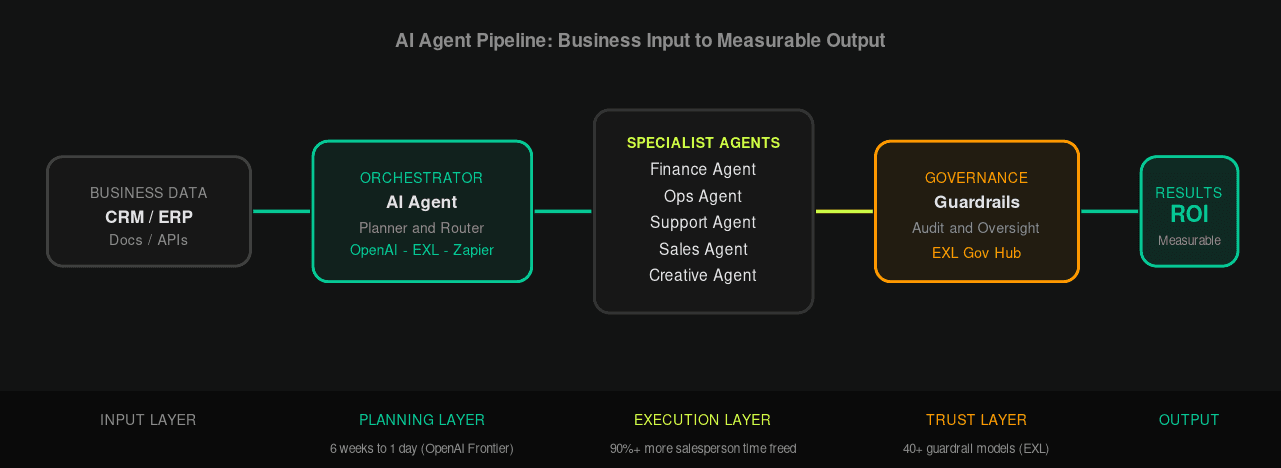
The AI Execution Gap: Why Your AI Pilot Is Stalling, And How to Cross the Finish Line

Ready to Build Something Great?

Book a free strategy call with our team and let's turn your idea into reality.

Book a Free Call

Share This Blog

The AI Execution Gap: Why Your AI Pilot Is Stalling — And How to Cross the Finish Line

AI Insights · March 2026

Author: Artilence Team
Published: March 13, 2026
Read Time: 6 min


Every boardroom is buzzing about AI. Budgets have been approved, demos have impressed, and pilots have launched.

But here's the uncomfortable truth:

Nearly half of all enterprise AI projects never make it to production.

The gap between “we're experimenting with AI” and “AI is delivering measurable ROI” is wider than most companies expected.

In 2026, that gap has a name:

The AI Execution Gap


What Is the AI Execution Gap?

The term gained attention at Enterprise Connect 2026, where Dialpad introduced a new agentic AI platform designed to help enterprises close it.

Their research confirmed what many executives already suspected:

The execution gap isn’t a technology problem — it's a deployment and workflow problem.

According to Gartner's 2026 Market Guide for Guardian Agents, organizations are deploying AI agents rapidly, but governance and oversight frameworks are lagging behind.

Despite strong adoption:

  • 50% of AI pilot projects stall before reaching scale
  • Many remain stuck in endless proof-of-concept cycles
  • Promising demos fail to produce real business impact

AI Adoption Reality (2026)

MetricInsight
70%Enterprises running AI agents in production (Gartner 2026)
50%AI pilot projects stall before scaling (Dialpad / Enterprise Connect)
88%Fully deployed AI programs report revenue gains (NVIDIA 2026)
80%AI initiative value comes from workflow redesign, not technology (PwC)

The core issue:

Most companies bolt AI onto existing workflows instead of redesigning workflows around AI.

This leaves a multi-trillion-dollar opportunity trapped in unfinished pilots.


“Technology delivers only about 20% of an AI initiative's value.
The other 80% comes from redesigning work — so agents can handle routine tasks and people can focus on what truly drives impact.”

— PwC 2026 AI Business Predictions Report


What’s Actually Happening Right Now?

The good news: the tools to close the gap already exist and are evolving rapidly.

Several major AI platforms launched in 2026 specifically to solve the execution gap problem.


Key AI Platforms Closing the Execution Gap

Tool / PlatformWhat It DoesBest ForStatus
Dialpad Agentic AIIdentifies high-impact use cases, builds autonomous communication agents, validates performance before rolloutCustomer service, sales teamsLive (2026)
OpenAI FrontierEnterprise platform for managing multi-vendor AI agents with granular access controlsLarge enterprisesLive (Feb 2026)
Anthropic Enterprise AgentsPre-built agents for finance research, engineering specs, and designFinance, engineering, legal teamsFeb 2026
Zapier AgentsSelf-directed AI agents across 8,000+ apps with no codeSMBs, ops teams, foundersExpanding (2026)

Real-World Examples

McKinsey

  • Candidates collaborate with its internal AI system Lilli
  • AI is used as a thinking partner in real business scenarios

L'Oréal

  • Integrated generative AI into marketing workflows
  • Reduced global campaign production time from weeks to hours

The companies winning at AI are not just buying tools.

They are building better processes.


What This Means for Your Business

The data tells a clear story:

Technology is not the bottleneck.
Organizational execution is.

Companies successfully scaling AI follow a different playbook.


The Winning AI Deployment Playbook

1. Map workflows before adding AI

Identify high-frequency tasks where automation creates leverage.

Best candidates:

  • repetitive
  • data-intensive
  • time-consuming

2. Set business KPIs (not tech goals)

Avoid goals like:

“Use more AI”

Instead define outcomes like:

  • Reduce response time by 40%
  • Cut report preparation from 4 hours to 20 minutes

If it can't be measured, it can't scale.


3. Choose tools that integrate with your stack

AI tools that operate in isolation create fragmentation.

Integration-first platforms like:

  • OpenAI Frontier
  • Anthropic Enterprise Agents

help avoid this.


4. Invest in AI-fluent teams

McKinsey already tests candidates on AI collaboration skills.

Winning companies are building:

  • AI-native teams
  • AI-first workflows
  • AI-assisted decision systems

Bridging the Gap with Artilence

At Artilence, we help companies move from AI pilot to AI production.

We design and implement:

  • custom AI workflows
  • enterprise integrations
  • AI agents tailored to your operations

Our senior AI engineers embed directly into your team to turn experiments into real deployments fast.

💰 Rates from $30 / engineer
🌐 https://artilence.com


The Bottom Line

The AI execution gap is real — but it's solvable.

Companies winning right now are not those with:

  • the biggest AI budgets
  • the flashiest demos

They are the ones who stopped treating AI as an experiment and started treating it as core infrastructure.

The results speak clearly:

88% of fully deployed AI programs generate direct revenue gains.

The only question left:

Will your organization cross the finish line —
or stay stuck in pilot purgatory?


Ready to Move From Pilot to Production?

Book a free 30-minute strategy call with the Artilence engineering team.

We’ll help you:

  • identify your highest-leverage AI opportunities
  • design a concrete deployment roadmap

👉 https://calendar.app.google/YVKUYYnLEpiHQyk68

💰 Rates from $30 / engineer


© 2026 Artilence
https://artilence.com

Artilence Newsletter

Don't worry your email is secure with us, We will use it to share the latest updates straight to your inbox!

Ready to Build Something Great?

Book a free strategy call with our team and let's turn your idea into reality.

Book a Free Call

Related Insights

AI Agents: From Experiment to Execution, The Enterprise Shift That's Happening Right Now
AI Insights

AI Agents: From Experiment to Execution, The Enterprise Shift That's Happening Right Now

AI Agents: From Experiment to Execution — The Enterprise Shift That's Happening Right Now AI Insights · March 2026 Author: Artilence Team Published: March 13, 2026 Read Time: 6 min !Enterprise AI Agent Ecosystem Here's a number that should stop you in your tracks: 88% of companies now use AI in at least one business function. Sounds impressive. But dig deeper and the picture changes quickly: Only 39% report a significant impact on their bottom line. That gap — nearly 50 percentage points wide — is the defining business challenge of 2026. And AI agents are how forward-thinking companies are closing it. The Era of Pilots Is Over For the past two years, AI strategy mostly meant experiments. - A chatbot here - A content generator there - A few internal tools nobody fully adopted The results were mixed. ROI was hard to measure. The skeptics had plenty of ammunition. But 2026 marks a shift. The conversation has moved from: Should we use AI? to How do we make AI work at scale? Deloitte's 2026 AI Report found that worker access to AI jumped 50% in 2025 alone, a sign that organizations are moving AI beyond innovation labs into everyday workflows. The next step is AI agents — autonomous systems that: - execute tasks - coordinate with software systems - drive measurable business outcomes AI Adoption Reality (2026) | Metric | Insight | |------|------| | 88% | Companies using AI in at least one function | | 39% | Companies seeing real bottom-line impact | | 40% | Enterprise apps expected to include AI agents by 2026 (Gartner) | | 50% | Increase in worker AI access in 2025 (Deloitte) | What AI Agents Are Doing in the Real World This is no longer hype. Enterprise deployments in 2026 are already producing dramatic results. OpenAI Frontier OpenAI's Frontier platform enables enterprises to build multi-agent orchestration systems. Examples include: - Manufacturing company: Production optimization reduced from 6 weeks to 1 day - Global investment firm: Sales teams gained 90% more selling time - Energy producer: Output increased 5%, generating $1B+ additional revenue EXL Agentic AI NASDAQ-listed EXL launched an enterprise agent platform in March 2026 with modular agents for: - data governance - data quality - lineage tracking - AI-ready pipelines Zapier Agents Zapier's agents allow teams to automate workflows across 8,000+ apps without code. Use cases include: - report generation - data processing - CRM updates - workflow automation Luma Agents Creative pipelines now run entirely through agents. Companies like: - Adidas - Mazda - Publicis use Luma Agents for: - text generation - image creation - video production - audio generation —all within a single agent workflow. "The true competitive advantage will belong to enterprises that have meticulously documented, secured, and exposed their proprietary business logic as high-quality, agent-callable APIs." — Enterprise AI Analyst, 2026 The Hidden Trap: Why 40% of Projects Fail Despite strong progress, the reality is sobering. Gartner predicts that 40% of agentic AI projects will be scrapped by 2027. Not because AI fails. But because companies fail to operationalize it. Common reasons include: - unclear ownership - weak system integration - legacy infrastructure - non-production architectures - agents that work in demos but fail at scale MIT Sloan researchers summarize it simply: Start by asking the right question. What problem are you actually trying to solve? Then build the correct combination of: - AI - traditional software - human oversight !AI Agent Pipeline Diagram What This Means for Your Business Companies successfully deploying AI agents share three traits: 1. They start with a specific problem Not: “Let's explore AI” But: “Let's reduce reporting time by 80%.” 2. They invest in the integration layer Agents must connect to real systems: - CRM - ERP - internal databases - analytics tools Disconnected tools create AI experiments, not AI infrastructure. 3. They hire engineers who bridge AI and production The rarest talent today is engineers who understand: - LLM orchestration - API architecture - enterprise integration - production deployment - AI security Example Results from Enterprise Agent Deployments | Company / Platform | Agent Capability | Result | |---|---|---| | OpenAI Frontier | Multi-agent orchestration | Production optimization: 6 weeks → 1 day | | EXL Agentic AI | Data governance & quality agents | 40 guardrail models deployed | | Zapier Agents | Cross-app workflow automation | No-code multi-step workflows | | Luma Agents | Creative AI pipelines | Used by Adidas, Mazda | | Generic AI pilot | Isolated tool | 40%+ projects scrapped (Gartner) | The Window Is Now Gartner predicts that: 40% of enterprise applications will include AI agents by the end of 2026. That means competitors are already: - deploying agents - building agent infrastructure - redesigning workflows around automation The question isn't whether agents will reshape your industry. It's whether your business will: - lead the shift - or be forced to react to it The companies investing today in: - integration - engineering talent - production-ready AI architecture will build advantages that are extremely hard to replicate later. The technology is ready. Execution is the real bottleneck. 💸 Rates from $30 / engineer https://artilence.com Ready to Move from Pilot to Production? Book a free 30-minute strategy call with the Artilence team. We'll help you: - identify your highest-value AI agent opportunity - design the architecture - scope a production-ready deployment plan 👉 https://calendar.app.google/YVKUYYnLEpiHQyk68 Senior AI Engineers · From $30/hr · Based in Pakistan · Working globally © 2026 Artilence AI Engineering Services — Pakistan https://artilence.com Sources - OpenAI Frontier - EXL Agentic AI (March 2026) - Gartner 2026 AI Predictions - Deloitte 2026 AI Report - MIT Sloan AI & Work 2026

By Artilence Team • March 13, 2026

AI Agents Are Your New Digital Coworkers
AI Insights

AI Agents Are Your New Digital Coworkers

For the past few years, AI was something you used — you asked it a question, it gave you an answer. That era is over. In 2026, AI doesn't wait to be asked. It plans, acts, learns, and delivers results across your entire business — without constant hand-holding. We call them AI agents, and they're the most important shift in how work gets done since the internet. If you're a founder, developer, or business owner trying to make sense of what's real vs. hype right now — this post is for you. !AI Agent network diagram So What Exactly Is an AI Agent? Think of a traditional AI tool like a vending machine. You put in a request → you get an output. An AI agent is more like a junior employee with a laptop, internet access, and a task list. It can: - browse the web - write code - send emails - generate reports - update your CRM - retry tasks when something fails —all on its own. Key difference: Traditional AI tools respond to prompts. AI agents pursue goals. They break down tasks, choose tools, execute step-by-step, and adapt when things don't go as planned. In 2026, these systems have moved from demos to production. Enterprises are deploying them in: - customer service - software development - operations - finance —not as experiments, but as revenue-generating infrastructure. AI Agent Market Signals | Metric | Stat | |------|------| | Projected AI agent market by 2034 | $200B | | Enterprises reporting gaps between AI ambition and reality | 63% | | Companies already using AI in at least one function | 88% | The Tools That Are Actually Working Right Now Here are four AI agent platforms making real impact in 2026. Salesforce Agentforce 3.0 Manages the entire customer lifecycle autonomously. Anticipates customer needs before they arise — not just a support bot. Zapier Agents AI teammates working across your entire app stack. Examples: - drafting emails - generating reports - syncing data - automating workflows —all without manual triggers. Google Antigravity Agents embedded directly into the software development environment. They can: - plan features - write code - test software - validate results with minimal human intervention. Beam AI Agents that learn from every interaction. This solves one of the biggest problems in enterprise AI deployments: ongoing maintenance and improvement. Where AI Is Already Solving Real Problems !AI across industries Healthcare AI is no longer just summarizing research. It's actively helping discover new drugs. AI-discovered drug candidates are already entering mid-to-late stage clinical trials, particularly in: - oncology - rare diseases Manufacturing Companies like PepsiCo are using AI-powered digital twins. Factories are simulated digitally before physical production begins. This identifies up to 90% of potential issues before deployment. Software Development This may be the biggest impact area. AI agents can now: - write code - test applications - review pull requests - deploy systems dramatically reducing build cycles and freeing engineers to focus on higher-level problems. What This Means for Your Business "The question is no longer if your business should use AI — it's how fast you can integrate it before your competitors do." Here's the uncomfortable reality: - 88% of companies say they use AI - only 39% report meaningful bottom-line impact The difference isn't access to tools. It's implementation. Off-the-shelf AI rarely fits real business workflows. Custom-built, integrated AI does. Most businesses are stuck in what we call the AI messy middle. They've: - bought subscriptions - tested pilots - experimented with tools But they haven't done the hard work of integrating AI into real operational workflows. The companies pulling ahead are not necessarily the ones with the largest AI budgets. They're the ones working with teams that understand both: - the technology - the business context well enough to build solutions that actually stick. AI agents are not science fiction. And they are no longer only for the Fortune 500. The infrastructure is mature. The tools are production-ready. The window to gain a real competitive advantage — before every company adopts this — is still open. But not for long. — The Artilence Team https://artilence.com

By Artilence Team • March 13, 2026

Client Logo

AI is our language, we speak it fluently. Let's innovate together.

LinkedIn
Instagram
Facebook
Youtube
Company
  • Home
  • Case Study
  • Careers
  • About Us
  • Privacy Policy
  • Blogs
Services
  • Frontend Development
  • Backend Development
  • Cloud / Database
  • Web Development
  • API Integrations
  • AI Development
  • UI / UX
  • DevOps
Artilence Newsletter

Don't worry your email is secure with us, We will use to share latest updates straight to your inbox!

© 2026 Artilence. All rights reserved.
icon
