


Ready to Build Something Great?
Book a free strategy call with our team and let's turn your idea into reality.
Share This Blog
Hire PyTorch Developers Who Can Get Your Model Into Users’ Hands
When you hire PyTorch developers, choose people who can make your model work with real customer data. A good demo is just the start.
For example, users may upload blurry photos or leave key details blank. They may also send lots of requests at once. As a result, a model that worked in a test may slow down or make mistakes.
For US teams, the key question is simple: can this person make the model useful in our product?
This guide shows you what to ask, what to test, and how to compare costs before you commit.
Hire PyTorch Developers Around One Clear Task
PyTorch is a tool for building and training deep learning models. These models learn patterns from examples, such as photos or text.
For example, a factory might use a model to spot torn labels. An online store might use one to group product photos.
Before you look for PyTorch developers for hire, write down the exact task.
“Build an AI tool” is too broad. Instead, try: “Flag torn shipping labels before boxes leave our warehouse.” This gives the developer a clear goal.
Your brief should answer five questions:
- What data will the model receive?
- What answer should it return?
- Which mistakes cause the most harm?
- How fast must it respond?
- Who checks results when the model is unsure?
Then, ask whether PyTorch fits the task. A simpler tool may solve the problem with less cost and upkeep.
Match the Developer to Your Current Problem
Different projects need different skills. For example, someone who trains image models may have little practice adding them to a busy app.
Choose PyTorch development services based on the work you need now.
| Your current problem | Experience to look for |
| You have labeled photos but no model | Training image models and checking results |
| Your model responds too slowly | Speed tests and memory checks |
| Results get worse with new data | Data checks and a review of errors |
| The model runs on only one laptop | Connecting models to apps and cloud systems |
| Your team cannot repeat past results | Saved settings, data versions, and setup guides |
Before you hire PyTorch developers, ask about one similar project. What did the person build? What went wrong? How did they check the fix?
Also, ask which parts they handled themselves. Clear answers tell you more than a long list of tools.
Look Beyond the Accuracy Score
A high score can hide a serious flaw. For example, imagine a factory where two boxes in every hundred are damaged.
A model could mark every box safe and reach 98% accuracy. However, it would miss every damaged box.
Before you hire PyTorch developers, ask how they would measure success for your task. They should explain which errors matter most.
Use questions such as:
- How many damaged items did the model miss?
- How many safe items did it flag by mistake?
- Did the test cover different cameras and lighting?
- Were test images kept out of the training data?
Also, ask to see failed examples. Strong PyTorch developers for hire should explain them in plain language.
Then, agree on when a person must check the model’s answer. This helps your team handle cases the model gets wrong.
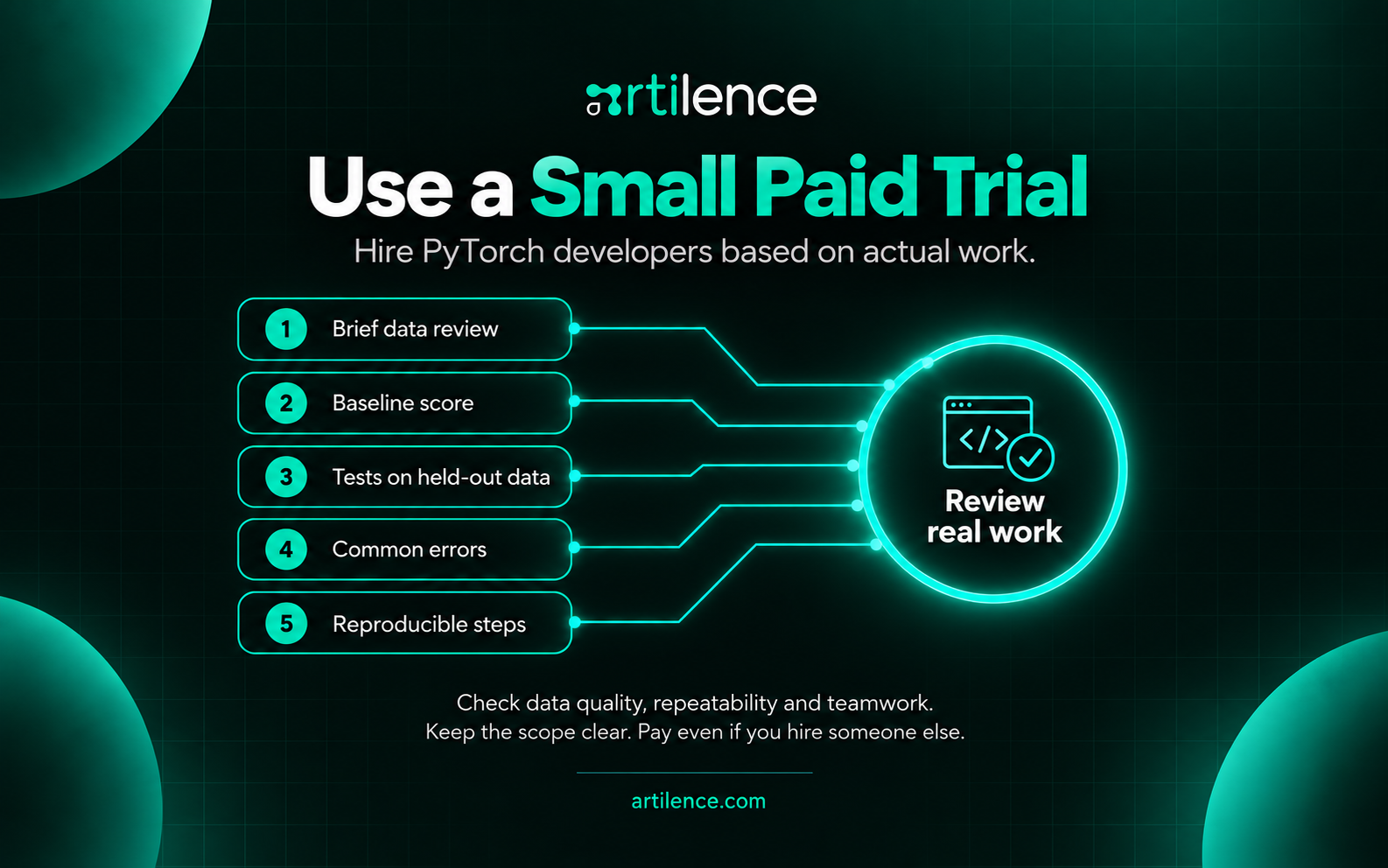
A short, paid trial helps you hire PyTorch developers based on their actual work. First, choose one task that reflects your product’s needs.
For example, share a small set of images you have permission to use. Ask the candidate to test an existing model and explain its weak spots.
Agree on these outputs before work starts:
- A brief review of the data.
- A starting score to compare against.
- Tests on data kept out of training.
- A list of common errors.
- Steps another engineer can follow.
Then, review the choices behind the code. Did the person spot copied images? Did they flag missing labels? Could your team repeat the test?
For dedicated PyTorch developers, also check teamwork. Ask them to explain a choice between speed and model quality to your product lead.
Finally, pay for the agreed scope, even if you choose someone else. Keep the trial small and the terms clear.
Compare the Full Cost of the Work
An hourly rate alone does not show the final cost. For example, one quote may cover data cleanup, tests, and launch support.
Another may cover only model training. As a result, the lower quote could leave more work for your team.
When you hire PyTorch developers, request separate costs for:
- Checking and cleaning your data.
- Building or adapting the model.
- Testing results and speed.
- Connecting the model to your app.
- Running cloud hardware.
- Fixing issues after launch.
For example, assume a rate of $75 per hour. At that rate, 120 hours would cost $9,000. This is a sample calculation, not a market rate.
Hardware, data labeling, and support would add to the bill. Also, ask what might change the quote, such as missing labels or a new feature.
Compare PyTorch development services using the same written scope. Then, check what each quote leaves out before you choose.
Choose a Setup That Fits Your Team
A freelancer can suit a small task when your team has someone to guide the work. An agency can suit a project that needs several skills.
For example, you may need model training, app code, and cloud setup at the same time.
Dedicated PyTorch developers can suit ongoing work. Over time, the same engineers learn your data and how your product works.
If you plan to hire PyTorch developers remotely, agree on these points first:
- Shared hours in your US time zone.
- Who checks code and approves changes.
- Where the team records progress.
- How urgent issues reach the developer.
- Who covers planned time off.
You do not need every work hour to overlap. However, you do need clear response times when someone is blocked.
Before you hire PyTorch developers, ask how they would plan a normal week with your team.
Agree on the Handover Before Work Starts
A model file alone is not a full handover. Your team also needs to know how to run it and fix a failed release.
Before you hire deep learning engineers, agree on what the final delivery includes.
First, request the code, model files, test results, and setup steps. Also, ask for the software versions needed to run the model.
Next, request a record of the data and settings used for training. This helps your team repeat the work later.
Agree on who owns the work and controls the cloud accounts. Then, define how access will pass to your team.
Finally, choose a backup plan. If the model stops working, should requests wait or go to a person? A clear plan helps avoid rushed choices after launch.
Set a Clear Review Point for Month One
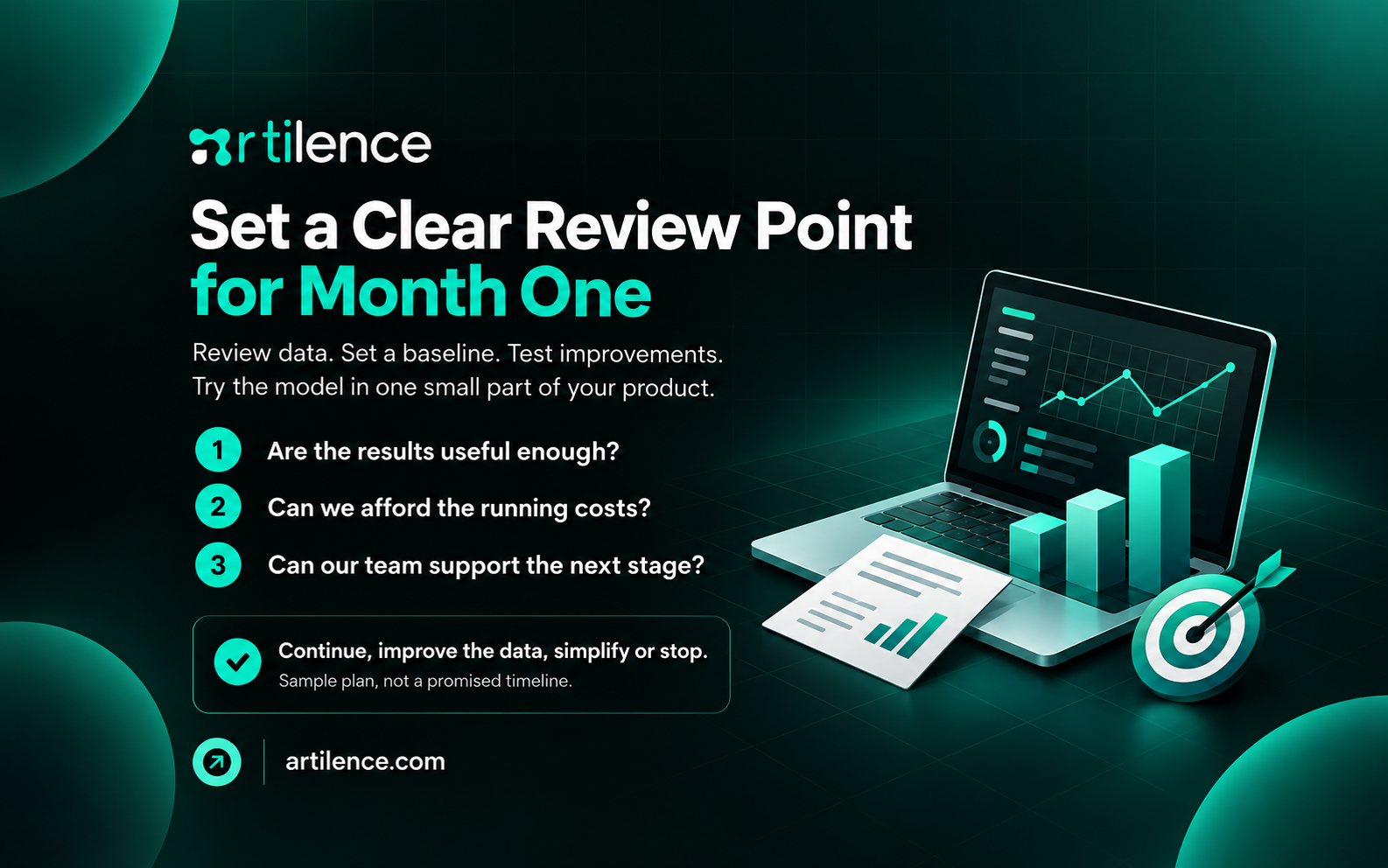
The first month should help you decide whether to keep funding the work. Start with a data review and a simple model to compare against.
Next, test whether changes improve the results that matter to your business. Then, try the model in one small part of your product.
At the review, ask:
- Are the results useful enough?
- Can we afford the running costs?
- Can our team support the next stage?
This is a sample plan, not a promised timeline. For example, poor data may require more cleanup before testing can start.
When you hire deep learning engineers, make room for an honest stop decision. Sometimes, better data or a simpler approach is the best next step.
Bring One Real Example to Your Hiring Call
Before you hire PyTorch developers, prepare one sample input and the answer you want. Also, share your expected usage and budget limits.
With these details, a developer can suggest a first step that fits your product.
Discuss Your Project With Artilence
Artilence offers AI and machine learning development for startups and growing businesses, including US teams. If you are comparing PyTorch development services, start with one real example from your product. Share the input, the answer you need, and the problem you face today. Then, ask the team about its proposed approach and relevant work. Also, agree on the test plan, costs, and handover before starting a larger build. This gives both sides a clear basis for the first stage.
Questions About Hiring PyTorch Developers
1. What does a PyTorch developer do?
A PyTorch developer builds, trains, and tests machine learning models. They may also connect models to apps and improve speed.
2. How much does it cost to hire PyTorch developers?
Cost depends on the scope, skills, and work needed. Therefore, ask for a quote that separates data work, coding, hardware, and support.
3. Which skills should I check?
Check Python, PyTorch, data handling, and model testing. Also, check cloud and app skills if the person will handle the launch.
4. Where can I find PyTorch developers for hire?
Look for PyTorch developers for hire through agencies, freelance sites, referrals, and open-source projects. Then, compare relevant work and paid trial results.
5. Should I choose a freelancer or dedicated developers?
A freelancer may fit a small, clear task. However, dedicated PyTorch developers may suit work that needs frequent updates and close teamwork.
6. Can remote developers work with US teams?
Yes, if the work setup fits both sides. First, agree on shared hours, response times, access, and who handles urgent issues.
7. Do I need PyTorch for a chatbot?
Not always. For example, a chatbot that calls an existing AI service may mainly need app development skills. Custom training may need PyTorch skills.
8. Can someone improve my existing model?
Yes, though the cause of the problem matters. For example, better labels or cleaner data may help more than a new model.
9. How long does a project take?
Timing depends on the data, task, and launch needs. Therefore, ask for separate estimates for the trial, first working version, and launch.
10. When should I hire deep learning engineers?
You may need to hire deep learning engineers for custom models that handle images, speech, or text. First, check whether simpler methods meet your needs.
Artilence Newsletter
Don't worry your email is secure with us, We will use it to share the latest updates straight to your inbox!
By subscribing, you agree to our Privacy Policy.
Ready to Build Something Great?
Book a free strategy call with our team and let's turn your idea into reality.
Related Insights


AI is our language, we speak it fluently. Let's innovate together.




Services
Artilence Newsletter
Don't worry your email is secure with us, We will use to share latest updates straight to your inbox!
By subscribing, you agree to our Privacy Policy.


