


Ready to Build Something Great?
Book a free strategy call with our team and let's turn your idea into reality.
Share This Blog
DevOps Services and Solutions That Keep Releases Moving
DevOps services and solutions help US businesses test code, release updates, and manage cloud systems. They reduce manual work and help teams find errors sooner. As a result, your team can deliver changes with fewer delays.
Your team finishes a feature on Tuesday. Yet customers cannot use it until Friday. First, someone must copy files. Then, another person checks settings.
Even after those checks, the update might fail.
A clear release process gives your team a safer way to make changes. It also helps people restore service when something goes wrong.
However, tools alone cannot fix every issue. Your team needs clear roles, useful tests, and a recovery plan that works.
Where DevOps Services and Solutions Earn Their Keep
DevOps brings software builders and system operators into one shared process. Both groups help keep updates safe and apps running.
A service is a task a provider handles. For example, it might involve setting up release tests.
A solution connects several tasks to fix a larger problem.
Imagine an online store that fails when shoppers use gift cards. The fix may need a checkout test, an error alert, and safer release steps.
Simply adding a dashboard would leave the main issue unresolved.
Therefore, DevOps consulting services should start by tracing the problem. The provider needs to understand what failed, why it failed, and who it affected.
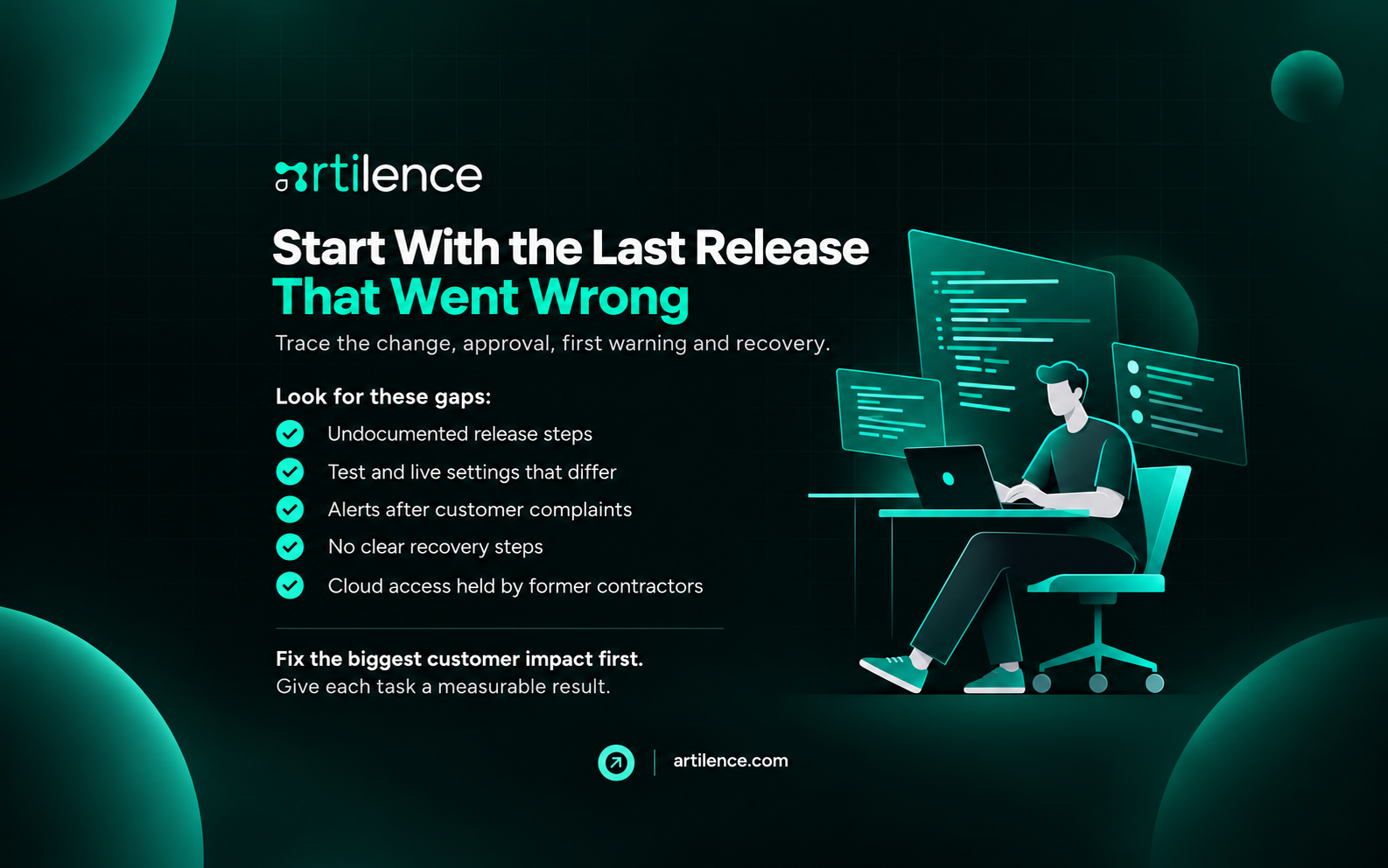
Start With the Last Release That Went Wrong
Your last failed update can show where help is needed.
First, check what changed. Then, find out who approved it and when the first warning appeared.
Next, review how the team restored service.
Look for gaps such as:
- Release steps kept in one person’s memory.
- Test settings that differ from live settings.
- Alerts that arrive after customer complaints.
- Updates without clear recovery steps.
- Cloud accounts controlled by former contractors.
After that, rank each gap by its effect on customers. A broken payment page should come before a slow internal report.
This gives DevOps services and solutions a clear purpose. Each task should address a known issue and include a way to check the result.
Build a Release Path Your Team Can Repeat
A release pipeline moves code through a set of steps. These steps can build the app, run tests, and prepare an update.
CI/CD pipeline services help teams build and maintain this process.
CI checks new code alongside existing code. Meanwhile, continuous delivery keeps tested changes ready for release.
Your team can still approve updates before they reach users. Automatic checks do not remove the need for human judgment.
For example, a billing update should test payments and failed charges. However, a simple text change may need fewer checks.
Also, keep passwords and access keys out of code. Store them in a secure system with controlled access.
Good DevOps automation services handle repeated work while keeping clear rules around risky changes.
Keep Test Settings Close to Live Settings
An app may work during testing but fail after release. Often, a setup difference causes the problem.
For instance, the test system may use an older database. Or someone may change a live setting without recording it.
Infrastructure as code stores setup instructions in files. As a result, teams can review changes and rebuild systems more easily.
Test systems can still be smaller than live systems. However, key settings should match where they affect app behavior.
Useful cloud DevOps services also check for changes made outside those files. Otherwise, the saved setup may drift from the real system.
Start with app settings, database versions, access rules, and network connections. Then, record who can change them.
Watch the Tasks Your Customers Depend On
A running server does not prove that an app works.
For example, users might sign in but fail to upload a file. A basic server check could miss that problem.
Instead, test the actions customers need:
- Can a new user create an account?
- Does checkout complete?
- Do background tasks finish?
- Can users open saved files?
Next, give each alert a named owner. Without one, a useful warning may sit unread.
For US teams, state support hours with a time zone. A team in California may need help after an overseas provider’s workday ends.
Also, explain who takes over during leave or illness.
DevOps automation services can send alerts and collect error details. However, people still need clear steps for handling the issue.
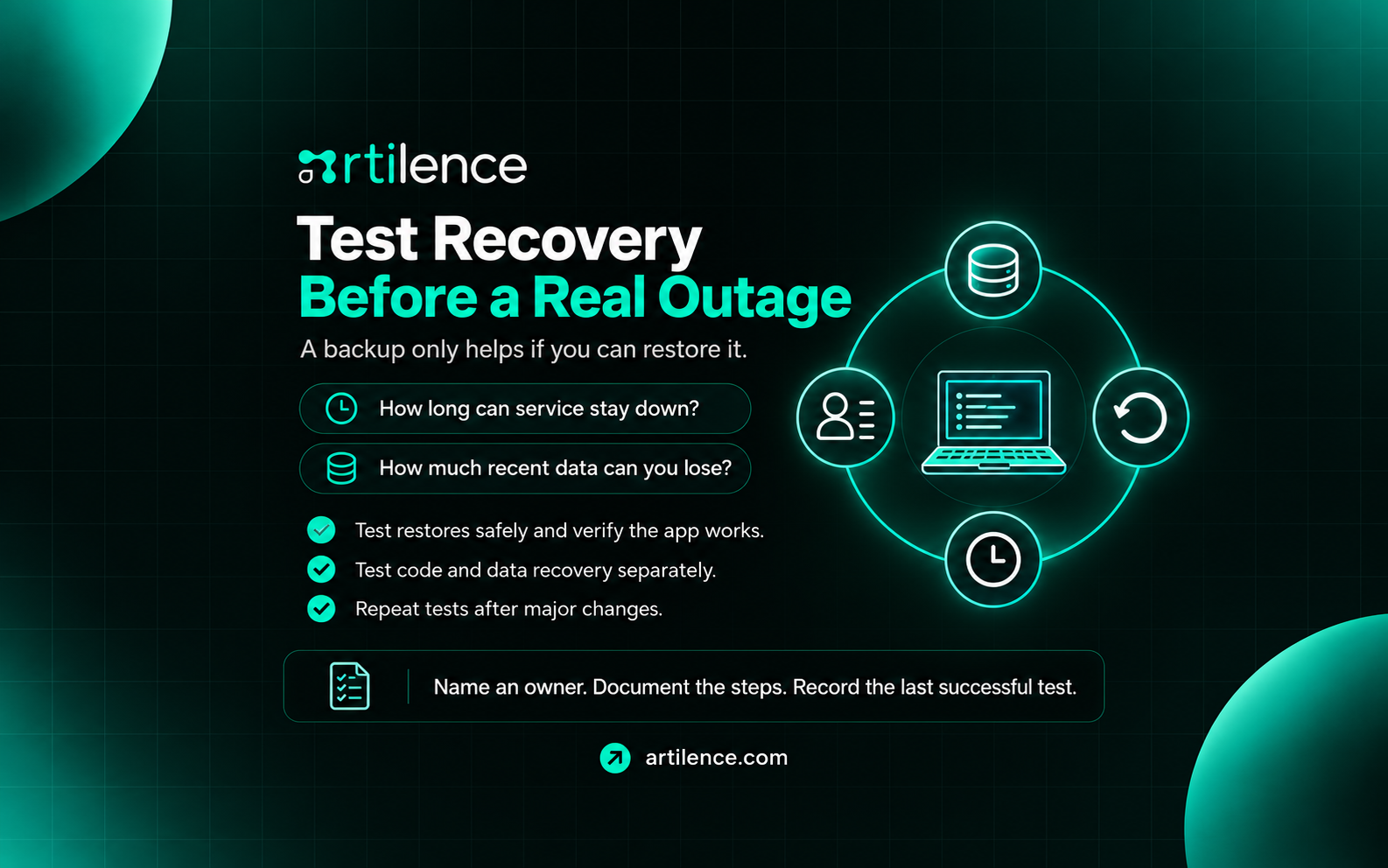
A backup is only useful if your team can restore it.
Therefore, test it in a safe system. Check that the saved data is complete and that the app can use it.
Also, treat code recovery and data recovery as separate tasks. Returning to old code may not undo a database change.
Before choosing a plan, answer two questions:
- How long can the service stay down?
- How much recent data could the business lose?
These answers shape backup timing, recovery steps, and cost.
Include recovery tests in DevOps services and solutions. Then, repeat them after major changes.
Each plan needs a named owner, clear instructions, and a record of the last successful test.
Reduce Cloud Waste With Careful Checks
A bigger server will not fix every slow app.
Sometimes, a slow database request causes the delay. In that case, buying more server capacity may waste money.
First, look for unused resources and oversized machines. Next, review test systems that run overnight or all weekend.
However, check what each system does before turning it off. A quiet server might handle an important monthly task.
Practical cloud DevOps services connect spending to business use. For example, you might track cloud cost per order or active account.
A higher bill may make sense when customer use grows faster.
Meanwhile, DevOps automation services can switch off approved test systems on a schedule. They can also flag sudden cost changes.
Ask for Results You Can Check
A proposal should explain what you receive and how you will test it.
For CI/CD pipeline services, ask for working release steps and clear test results. Also, request a demonstration of what happens when a release fails.
For cloud DevOps services, ask for setup files, cost reports, alerts, and recovery instructions.
Keep cloud accounts and code under your company’s control. Then, give the provider only the access needed for the work.
Your DevOps consulting services agreement should separate setup from ongoing support. It should also explain response times, extra charges, and tasks outside the scope.
Finally, compare matching proposals. A setup-only price cannot fairly be compared with a plan that includes ongoing support.
Track Whether Daily Work Gets Easier
Faster releases matter when they remain safe.
First, measure how long a change takes to reach users. Then, track failed updates, recovery time, and manual work.
Compare those results with your own starting point.
For example, fewer release steps may save time. However, removing a payment test could lead to costly errors.
Review several releases before judging the change. One smooth update does not prove that every problem is solved.
Also, ask whether developers spend less time fixing setup issues. Check whether customers face fewer errors.
Together, these measures show whether DevOps services and solutions improve daily work.
Bring a Clear Release Problem to Artilence
Artilence offers release automation, software testing, cloud management, monitoring, and setup management through code. Start the discussion with your current release steps and recent problems. Then, agree on a focused scope with clear checks. When exploring DevOps consulting services, choose one measurable issue first. For example, you might address failed updates or mismatched settings. This gives your team and Artilence a shared result to work toward.
Common Questions About DevOps Providers and Careers
1. What careers are available in DevOps services and solutions?
Common roles include DevOps engineer, cloud engineer, release engineer, and site reliability engineer. These jobs involve testing, automation, cloud systems, and software support. Useful skills include Linux, scripting, version control, and problem-solving.
2. Can a DevOps services provider in Pakistan support a US business?
Yes, a provider in Pakistan can work remotely with a US team. However, agree on time zone overlap, access controls, and support hours before starting. Also, confirm who handles urgent issues outside normal working hours.
3. What should a DevOps services company deliver?
A provider should deliver the release steps, cloud setup, tests, or monitoring agreed in your scope. Also, ask for clear records, recovery instructions, and a handover. Keep your company in control of its accounts and code.
4. What should I look for on a DevOps services website?
Look for clear service details, relevant project examples, and an explained delivery process. Then, check whether the provider describes support coverage and ongoing care. A list of tools alone does not show how the team solves problems.
5. What do DevOps consulting services include?
DevOps consulting services often begin with a review of your release process and cloud setup. Next, the consultant identifies gaps and suggests fixes. Confirm whether the price covers advice, hands-on work, or both.
6. When should a business hire a DevOps consultant?
Consider a consultant when releases keep failing, cloud costs lack clear owners, or manual tasks delay updates. A consultant can help find the cause and plan improvements. However, ongoing daily support may need a separate agreement.
7. How should I compare OrangeMantra with another DevOps provider?
Ask each provider to quote for the same scope, support hours, and deliverables. Then, compare relevant experience, handover plans, account ownership, and total costs. Request a walkthrough of how each team would address your specific release problem.
Artilence Newsletter
Don't worry your email is secure with us, We will use it to share the latest updates straight to your inbox!
By subscribing, you agree to our Privacy Policy.
Ready to Build Something Great?
Book a free strategy call with our team and let's turn your idea into reality.
Related Insights


AI is our language, we speak it fluently. Let's innovate together.




Services
Artilence Newsletter
Don't worry your email is secure with us, We will use to share latest updates straight to your inbox!
By subscribing, you agree to our Privacy Policy.


