


Ready to Build Something Great?
Book a free strategy call with our team and let's turn your idea into reality.
Share This Blog
DevOps Development Services: Build a Pit Crew for Your Software
DevOps development services help your team release software faster and with fewer mistakes. Think of a race car pit stop. In about two seconds, four tires change. That is possible because each person has one job and a clear plan. Likewise, software teams can work the same way with DevOps development services. This guide shows how DevOps development services work. It also covers which team model fits your budget and what to expect in the first three months. Every idea uses plain words, so anyone can follow along.
Why Race Teams Obsess Over Two Seconds
A pit stop looks wild, yet nothing in it is random. In fact, each crew member trains for one task. They practice it hundreds of times. Because of that, the car returns to the track fast and safe.
Software releases need the same calm rhythm. However, many US companies still release code by hand. For example, one person copies files. Another restarts a server. Then everyone crosses their fingers.
Slow releases cost real money. First, customers wait for fixes. Second, developers lose days on chores. Meanwhile, rivals ship new features. Good DevOps development services replace that scramble with a written, tested routine. In other words, they build your pit crew.
What a Calm Release Day Looks Like
Imagine a normal Tuesday. At ten, a developer finishes a small feature. Soon after, tools test it within minutes. Then a teammate reviews it before lunch. By two o'clock, a few customers can already use it.
If all looks well, everyone gets it by evening. As a result, there is no late night and no panic. Even if something goes wrong, a rollback button brings back the old version in minutes. That calm is the real goal of DevOps development services.
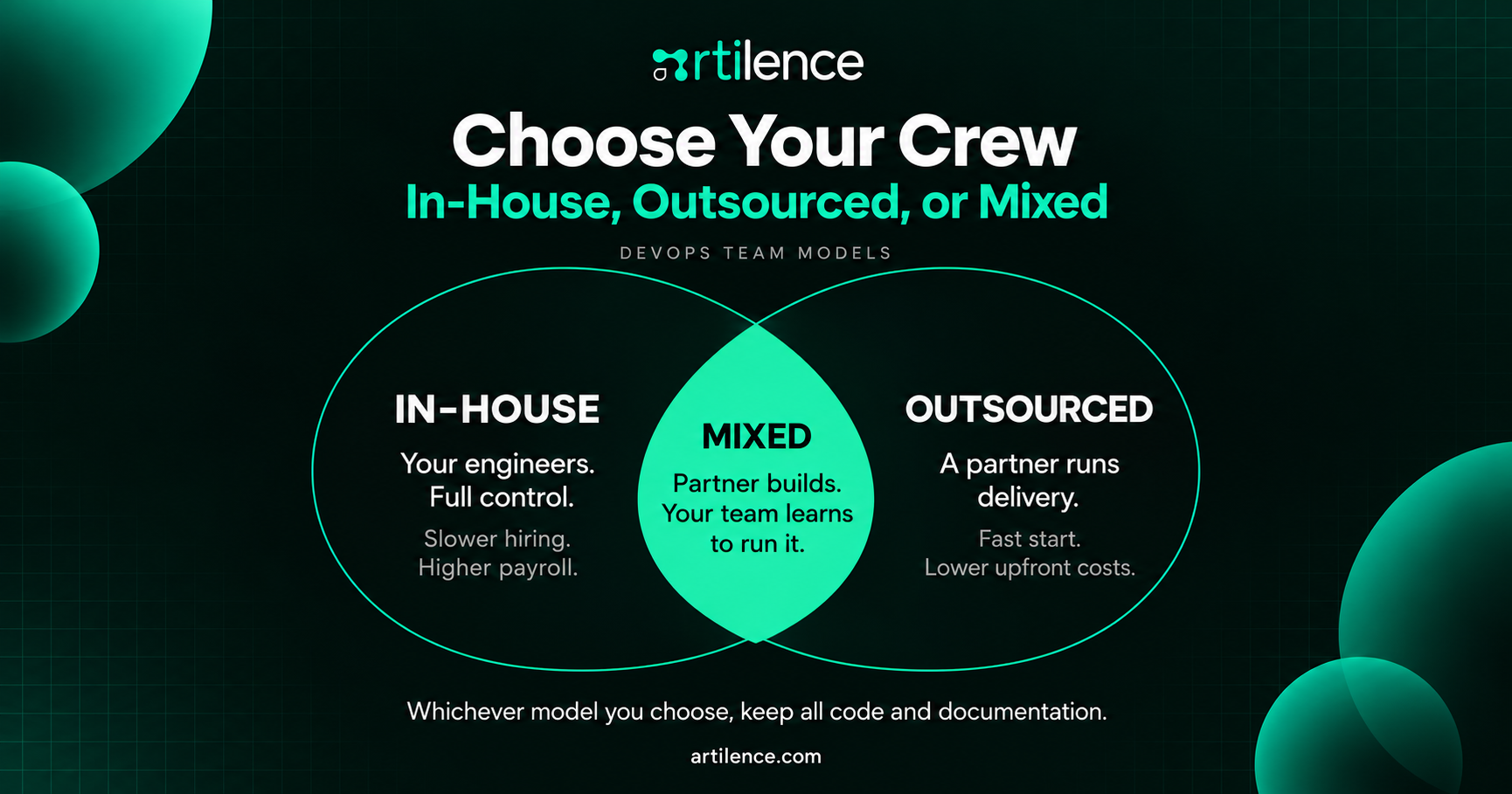
Choose Your Crew: In-House, Outsourced, or Mixed
You have three ways to build the crew. In fact, each one suits a different company.
- In-house: you hire your own engineers. This gives you full control. However, hiring is slow and pay is high.
- Outsourced: a partner does the work. This path is called DevOps outsourcing. It starts fast and, in many cases, costs less at first.
- Mixed: a partner builds the base, and your staff learn to run it. For this reason, many teams like this path best.
Small firms often lack time to hire. Therefore, for them, DevOps outsourcing works well. On the other hand, large firms may already own a strong core team. In that case, outside help fills gaps, such as night support or a cloud move.
Whichever model you pick, ask for one thing. Your team should keep all the code and notes. Otherwise, you may feel stuck later.
What You Get From DevOps as a Service
DevOps as a service is a monthly plan. In this setup, a partner runs your release tools, cloud setup, and alerts. You pay a steady fee instead of building a team from zero.
Most plans include these parts:
- Release tools that test and ship your code.
- Cloud setup that follows written rules.
- Alerts that wake the right person.
- Monthly reports in plain words.
- Expert help when something breaks.
This model fits startups and growing firms well. Moreover, fees are easy to predict. Also, you can add or drop help as your needs change. Still, read the contract with care. Ask what happens if you leave. Strong DevOps development services never lock you in.
Price is the next question. Because every company differs, fees depend on team size, cloud use, and how much support you need. A plan for one app costs far less than a plan for ten. Because of this, ask for a fixed scope and a written list of deliverables. Also ask if cloud cost optimization is part of the plan. In some cases, it can offset part of the fee. A good DevOps as a service partner will answer without delay.
Working With a Team in Another Time Zone
Many US firms hire partners abroad. Indeed, this can be a big plus. While your office sleeps, the partner can keep working. However, it only works with good habits.
- First, agree on two or three overlap hours each day.
- Also, share one task board that everyone can see.
- Then write short handoff notes at the end of each shift.
- Finally, name one contact for emergencies.
With these steps, nobody waits a full day for an answer. In short, good DevOps development services fit around your clock. In fact, your release queue keeps moving around the clock. Teams that use DevOps outsourcing well often fix night problems before US staff wake up.
Kubernetes Without the Headache
Picture a busy port. There, goods travel in standard steel boxes. Because the boxes match, cranes and ships move them with ease. Likewise, software containers work the same way. Each container holds an app and everything it needs.
In this picture, Kubernetes is the port manager. First, it starts containers, moves them, and replaces broken ones. If traffic jumps, it adds more copies. When traffic drops, it removes them.
Does every company need Kubernetes? No. For example, a simple site with steady traffic may run fine without it. Meanwhile, apps with many parts and busy seasons gain a lot. Online shops during holiday sales are a good example.
A wise partner starts with your real needs. Instead, they never push heavy tools just because those tools are popular. So, ask them why Kubernetes fits you. Their answer should be short and clear, since clear DevOps development services start with plain talk.
Cut Cloud Bills Without Slowing Down
Cloud bills often grow quietly. For instance, a test server runs all weekend. Likewise, a big machine sits half empty. Nobody notices until the invoice arrives.
Cloud cost optimization means paying only for what you use. DevOps teams do this in simple ways, such as these:
- First, turn off test systems at night.
- Next, match machine size to real demand.
- Then delete old backups and unused disks.
- Also, add tags so every cost has an owner.
- Finally, set alerts when spending jumps.
Automation helps here. For example, a small script can shut down idle systems on a schedule. As a result, savings repeat every month without extra effort. Good cloud cost optimization never hurts speed. Instead, it simply removes waste.
A Small Online Shop Tries the Pit Crew Plan
Here is an example, not a real client story. Picture a shop with six developers. It sells across the US and ships updates once a month. Because each release takes a full Saturday, work piles up. Also, only two people know the steps. When one of them gets sick, the release waits.
So the owner chooses DevOps as a service to start. First, the partner builds a simple release path for the main app. Next, it sets alerts for slow pages. It also reviews the cloud bill and spots test systems running all night. That first round of cloud cost optimization trims waste right away.
Within three months, the shop releases every week. As a result, Saturdays are free again. Moreover, the owner can finally see which system costs what. Of course, not every shop will see the same gains. Still, the pattern is common. In short, small, steady steps beat big, risky rebuilds.
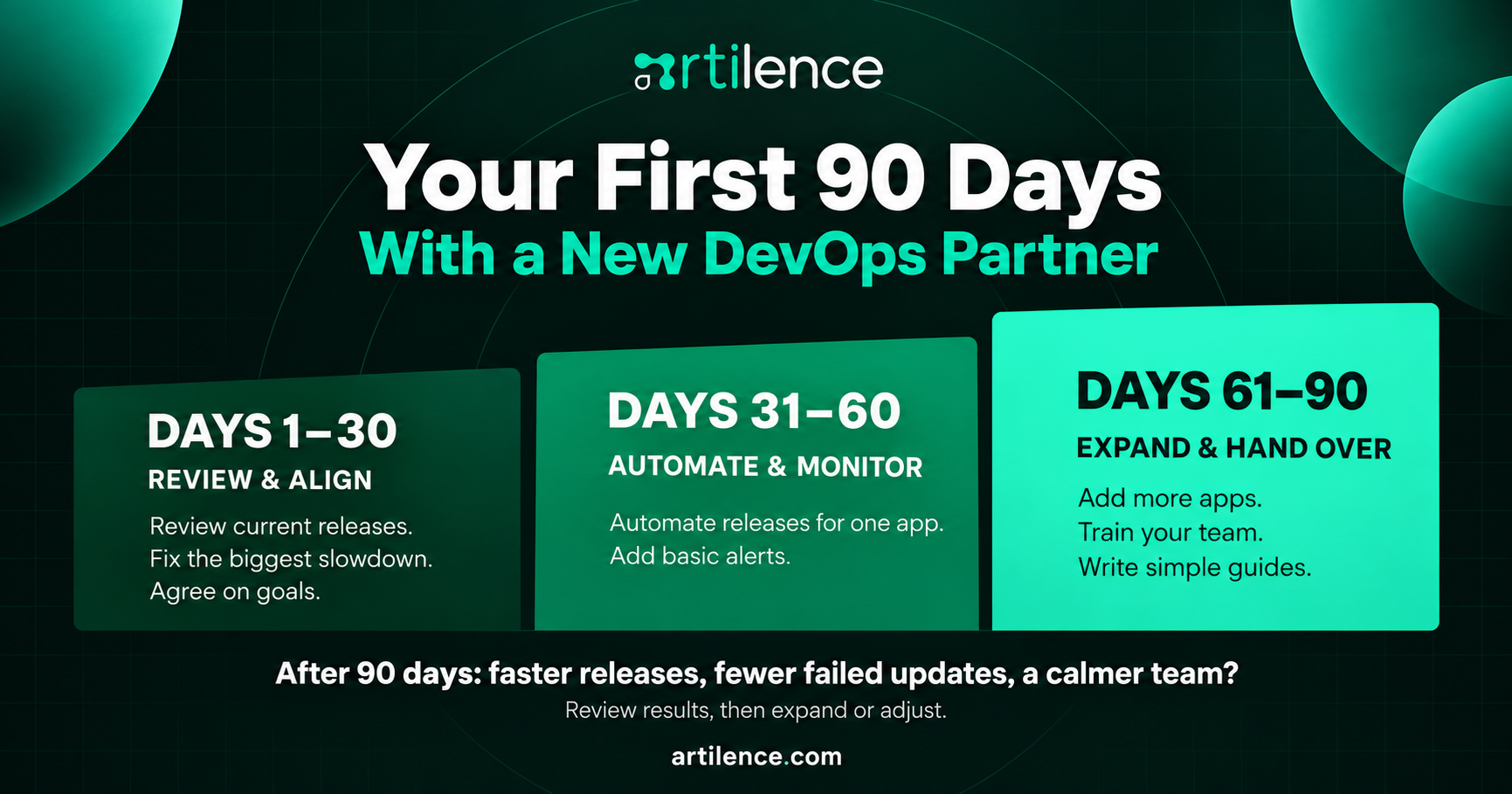
Your First 90 Days With a New DevOps Partner
A clear plan keeps the work calm. For this reason, here is a simple timeline.
- Days 1 to 30: review how you release today. Then fix the biggest slowdown first. Also agree on goals.
- Days 31 to 60: build the first automated release path for one app. Next, add basic alerts.
- Days 61 to 90: then add more apps, train your staff, and write simple guides.
After 90 days, check your results. For example, are releases faster? Do fewer updates fail? Is your team calmer? If so, expand the plan. If not, adjust before you spend more. Honest DevOps development services welcome this check.
Keep the Crew Sharp After Launch
Pit crews train even in the off season. Likewise, your DevOps crew should do the same. After all, systems change, and people move on.
Try these habits:
- First, hold a short practice drill each quarter. Pretend a server fails, then fix it together.
- Also, write a plain guide for each common problem.
- Next, review every outage without blame. Ask what the process missed, not who slipped.
- Finally, rotate who answers alerts so no one burns out.
These habits cost little. Yet they also stop small issues from becoming long outages. Over time, your DevOps as a service plan or in-house crew grows stronger.
Six Words You Will Hear in Every DevOps Meeting
- Pipeline: the path your code follows from laptop to live site.
- Container: a sealed box that holds an app and its parts.
- Alert: a message that warns you about a problem.
- Rollback: a quick return to the last good version.
- Uptime: the share of time your site works.
- Cloud: rented computers that you reach online.
Once you learn these six, most talks become much easier to follow.
About Artilence
Artilence is a US-headquartered technology company with delivery teams in Asia. It helps businesses with AI automation, data infrastructure, full-stack development, cybersecurity, and SEO growth. In addition, it offers DevOps development services for growing teams. Its engineers can set up release tools, cloud systems, and DevOps outsourcing support that fit your budget. First, work starts with a clear plan, and security stays in view from day one. Your staff also receive hands-on training and simple guides. As a result, you keep full control of your systems.
Start With One App, Not Everything
First, pick the one app that hurts the most. Next, map how it ships today. Then compare the three team models in this guide. With the right DevOps development services, release day turns into a routine. Your pit crew will then be ready for the next race. In the end, the goal is simple. You want faster releases, steadier systems, and a team that sleeps well at night.
Frequently Asked Questions
1. What is DevOps as a service?
It is a monthly plan where a partner runs your release tools, cloud setup, and alerts. As a result, you get expert help without hiring a full team. Fees are usually steady and easy to plan.
2. What are the main benefits of DevOps?
Strong DevOps development services help teams ship updates faster and with fewer errors. They also cut manual work and make problems easier to spot. As a result, customers see fixes sooner.
3. What is the DevOps lifecycle?
It is a loop of steps: plan, code, build, test, release, run, and monitor. In fact, what you learn from monitoring feeds the next plan. Because of this, the loop never really stops.
4. Is DevOps outsourcing safe?
It can be very safe with the right partner. First, ask for clear access rules, signed privacy terms, and full code ownership. Also, check how the partner handles security checks.
5. Is Kubernetes necessary for DevOps?
No. Kubernetes helps when you run many containers and need them to scale. However, smaller apps often work well with simpler tools.
6. What is the difference between DevOps and SRE?
DevOps is a way of working that joins developers and operations staff. SRE, or site reliability engineering, is a job role that uses code to keep systems steady. In practice, many teams use both ideas together.
7. How can DevOps reduce cloud costs?
DevOps teams track spending, shut down idle systems, and size machines to real demand. Then automation repeats these savings each month. Also, clear tags show which team owns each cost.
8. Does DevOps require coding?
Yes, at a basic level. For example, DevOps engineers write scripts and setup files to automate work. However, they do not need to build full apps.
9. Which cloud is best for DevOps: AWS, Azure, or Google Cloud?
All three work well. However, the best choice depends on your app, your team's skills, and your budget. In practice, many US firms pick the cloud their staff already know.
10. How soon will I see results from DevOps?
After starting DevOps development services, many teams see small wins in month one, such as fewer manual steps. Then larger gains, like faster releases, often show up in about three months. Also, results grow as you add more apps.
Artilence Newsletter
Don't worry your email is secure with us, We will use it to share the latest updates straight to your inbox!
By subscribing, you agree to our Privacy Policy.
Ready to Build Something Great?
Book a free strategy call with our team and let's turn your idea into reality.
Related Insights


AI is our language, we speak it fluently. Let's innovate together.




Services
Artilence Newsletter
Don't worry your email is secure with us, We will use to share latest updates straight to your inbox!
By subscribing, you agree to our Privacy Policy.


