


Ready to Build Something Great?
Book a free strategy call with our team and let's turn your idea into reality.
Share This Blog
AI Chatbot Development Services: How Good Chat Conversations Are Built
You have met a bad bot before. You type a simple question, and the reply makes no sense. So you give up and call a person. That poor result often has little to do with the tech. It comes from weak planning. Good AI chatbot development services focus on the conversation first and the code second. This guide shows how a helpful conversational AI chatbot is shaped, step by step, in plain words. Along the way, you will see what AI chatbot development services should cover for a US business.
Why Some Bots Help and Others Annoy
Think about the last time a bot helped you. It likely answered fast, spoke simply, and knew when to stop. Now think about a bad one. It probably repeated itself or ignored your question.
The gap between the two is rarely about money. Instead, it comes down to chatbot conversation design. That means planning what the bot says, when it says it, and how it sounds.
Many US teams skip this part. They rush to launch, and then customers pay the price. As a result, the bot gets blamed for a plan that never existed. However, strong AI chatbot development services treat the chat like a small product. It needs a goal, a voice, and a set of rules. Before you pick a partner, ask how their AI chatbot development services handle each of the next steps.
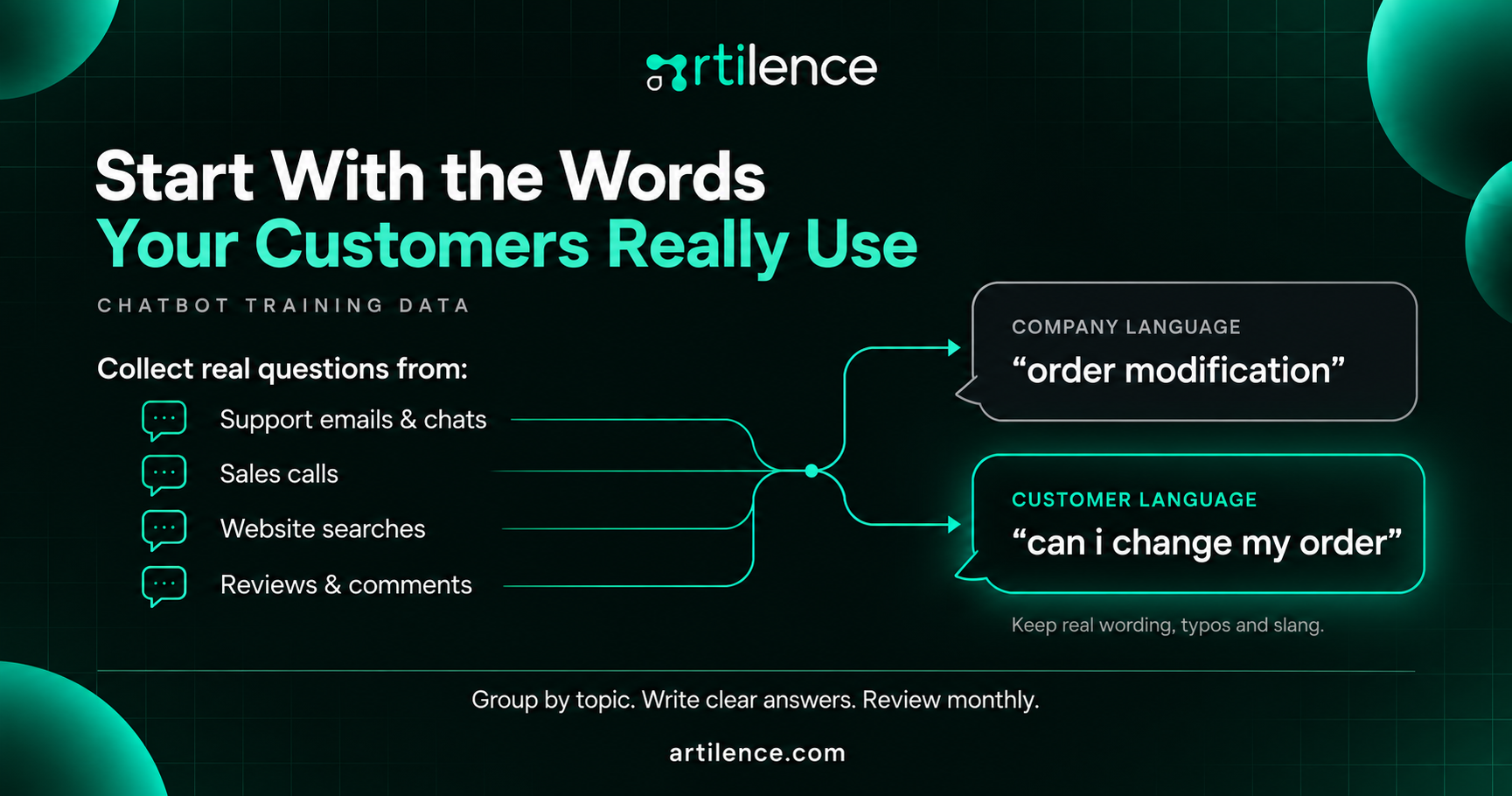
Start With the Words Your Customers Really Use
A bot learns from examples. Those examples are its chatbot training data. Most teams make one big mistake here. They write questions the way the company talks. Customers never talk that way.
For instance, your site may say "order modification." A customer will type "can i change my order." So if the bot only knows the first phrase, it fails.
So collect real messages first. Good places to look include:
- Old support emails and chat logs
- Questions your sales team hears on calls
- Search words from your own website
- Reviews and social media comments
Next, group the messages by topic. Then write one clear answer for each. Also keep typos and slang in the list. People type fast, and the bot must cope.
Quality matters more than size. Fifty clean examples beat five hundred messy ones. Also, update the list each month, because customers change how they ask. Because of that, a real person should review all chatbot training data before it goes live.
Give Your Bot a Voice People Can Trust
Every bot has a personality, even if nobody chose it. A bot that sounds cold feels cold. A bot that jokes too much can feel silly when someone has a real problem.
Pick three words that describe your brand voice. For example, "friendly, calm, and clear" works well for a bank. "Playful, quick, and warm" may suit a pet shop.
Then write a few sample replies in that voice. Share them with your team. If everyone nods, you have the tone right.
Strong chatbot conversation design also covers small details:
- A short greeting that says what the bot can do
- A bot name, so users know they are not talking to a person
- Plain words, with no slang the user may not know
- One idea per message
Be honest about what the bot is. Say it is a virtual helper in the first line. Honesty builds trust, and it avoids confusion later. Besides that, it keeps your bot in line with fair advertising rules.
Plan for the "I Do Not Understand" Moment
Every bot gets confused. The goal is not to stop that. Instead, the goal is to handle it well.
A weak bot says, "Sorry, I did not get that," again and again. Users feel trapped. A better bot tries a new way to help.
Here is a simple three-step plan:
- Ask in a different way, or offer two or three buttons.
- If the bot still fails, say so honestly.
- Offer a way to reach a person, or take a message.
The second try matters most. For example, the bot could say, "I may have missed that. Are you asking about shipping, returns, or billing?" Buttons make it easy to answer.
Good AI chatbot development services build this plan in from day one. They never add it as an afterthought.
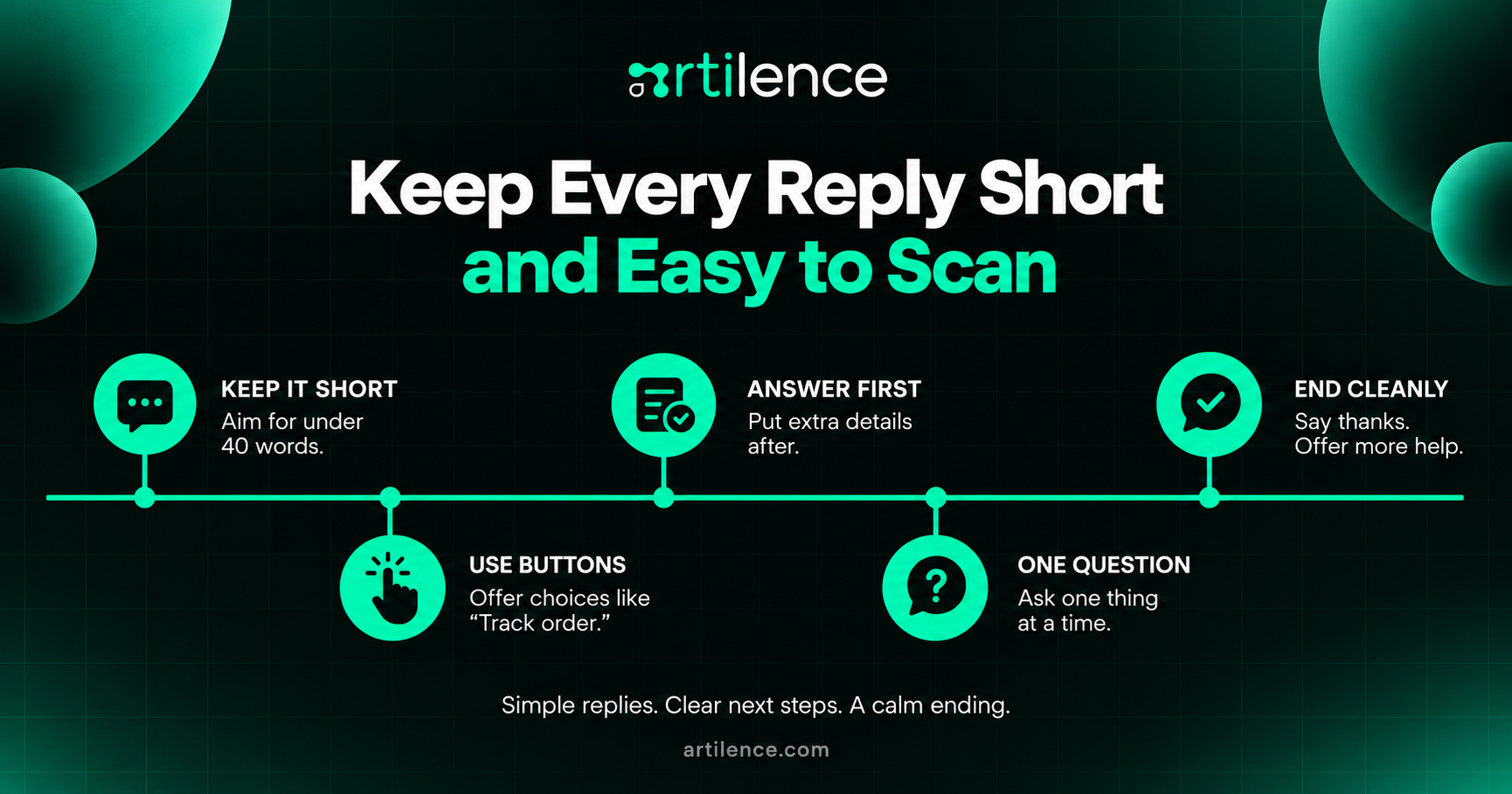
Keep Every Reply Short and Easy to Scan
Most people read chats on a phone. Long blocks of text get skipped. As a result, short replies work best.
Follow these simple rules:
- Keep each reply under 40 words when you can.
- Use buttons for common choices, such as "Track order."
- Put the answer first and the extra details after.
- Ask only one question at a time.
Also think about the flow. Suppose a customer asks, "Where is my order?" A good bot asks for the order number and gives the date. However, it never asks five extra questions.
Finally, think about the end of the chat. Say thanks, and ask if there is anything else. Then let the person go. A calm, clean ending leaves a good last impression.
Teach the Bot What It Must Never Say
Modern bots can write long, smooth answers. However, they can also make things up. A smooth wrong answer may be worse than no answer at all.
So you need guardrails. These are rules that keep the bot inside safe limits. Common ones include:
- Answer only from approved company content
- Never guess prices, dates, or policies
- Never ask for card numbers or passwords in chat
- Stay away from legal and medical advice
- Pass angry or upset users to a person
Strong AI chatbot development services write these rules down and test them. They also limit what the bot can see. A bot that cannot see private data cannot leak it.
In addition, review the rules every few months. Your business changes, so the rules must change too.
Test Like a Real Customer, Not Like a Developer
Developers test the happy path. Customers do not stay on it. They type in all caps, and they misspell words. Some even ask two things at once.
Good chatbot testing copies this mess on purpose. Here is a simple plan:
- Write 50 real questions from your logs.
- Add 20 messy ones, with typos and slang.
- Add 10 tricky ones, like off-topic or rude messages.
- Ask five people outside your team to try the bot.
- Fix every wrong or odd reply, and then test again.
Watch for three things. First, check that the bot answers correctly. Next, check that it sounds right. Finally, make sure it stops when it should.
Because chatbot testing catches problems before customers do, it saves money. Fixing a reply takes minutes. Losing a customer costs far more.
Read Real Chats After Launch
Launch day is the start, not the finish. Real users will ask things you never planned for. For that reason, ongoing care is part of good AI chatbot development services.
So set a weekly habit. Read ten to twenty chats. Look for places where users got stuck, left early, or asked for a person.
Then make small fixes. Add a new answer. Rename a button. Cut a long reply. Small, steady changes add up fast.
Over time, your conversational AI chatbot gets sharper. It learns your customers' habits, and it answers faster. That is how a decent bot becomes a great one. Good chatbot testing should continue after launch, too.
One Chat From Start to Finish: A Shoe Store Return
Let us see these ideas working together. Imagine an online shoe store.
A customer types, "need 2 return shoes, wrong size." The bot greets her and says it can help. Because the training data included "return" and "wrong size," it understands. It asks for the order number with one short question.
Then it checks the order. It replies in two lines: the return window, and a button for a free label. The customer taps the button, and she is done in under a minute.
Next, the bot asks if she wants a different size. She says yes, and it shows two options. Now imagine she asked something odd, like returning shoes she wore for a year. The guardrails would apply. The bot would not guess. Instead, it would pass her to a person with the chat notes attached.
That is what good chatbot conversation design feels like. The customer never thinks about the tech. She just gets help. In the end, that is the real goal of AI chatbot development services.
About Artilence
Artilence is a US-headquartered tech company with delivery teams in Asia. We build AI automation, data systems, and custom software for growing businesses. Our team also supports cybersecurity and search growth, so your tools stay safe and easy to find. If you want AI chatbot development services built on real conversations, we can help. We plan, build, and improve your bot with you.
Frequently Asked Questions
What are AI chatbot development services?
They cover planning, building, testing, and improving a bot that chats with your customers. A team designs the conversation, links the bot to your tools, and keeps it up to date. Good AI chatbot development services also train your staff to manage it.
How does an AI chatbot learn?
It learns from examples, such as past chats, FAQs, and help pages. Teams feed in this chatbot training data and then check the answers. The bot keeps improving as people review real chats.
How long does it take to build an AI chatbot?
A simple bot can take two to four weeks. A custom bot linked to many tools may take two to three months. Clear goals and clean content speed things up.
How much does an AI chatbot cost?
Simple bots may start at a few hundred dollars a month. Custom builds often cost several thousand dollars or more. The price depends on the tools, the data, and the support you need.
Why does my chatbot give wrong answers?
Often the bot has old content or no guardrails. Fix the source content first, and then add rules about what it can say. Regular chatbot testing also catches these slips early.
What is NLP in a chatbot?
NLP means natural language processing. It helps a bot understand what a person means, even when the words are messy. For example, it sees that "cant log in" and "password not working" are the same problem.
Can a chatbot remember past conversations?
Yes, if the team builds memory into it. The bot can save details like a name or order number, with the user's permission. Without memory, it starts fresh every chat.
Can chatbots replace human support agents?
Not fully. A bot handles simple, repeat questions very well. People are still needed for tricky, emotional, or high-stakes problems.
What is the difference between a chatbot and conversational AI?
A chatbot is the tool people chat with. Conversational AI is the technology behind it. A conversational AI chatbot can understand context and reply in natural language.
Is an AI chatbot safe for customer data?
It can be, when set up with care. Good teams limit what the bot can see and encrypt stored data. They also avoid asking for passwords or card numbers in chat.
Artilence Newsletter
Don't worry your email is secure with us, We will use it to share the latest updates straight to your inbox!
By subscribing, you agree to our Privacy Policy.
Ready to Build Something Great?
Book a free strategy call with our team and let's turn your idea into reality.
Related Insights


AI is our language, we speak it fluently. Let's innovate together.




Services
Artilence Newsletter
Don't worry your email is secure with us, We will use to share latest updates straight to your inbox!
By subscribing, you agree to our Privacy Policy.


