

Chatbot Development Services: What They Include & How to Choose (2026)
Ready to Build Something Great?
Book a free strategy call with our team and let's turn your idea into reality.
Share This Blog
Chatbot development services help you build a bot that talks to your customers. It can answer questions, book calls, and fix simple problems. Best of all, it works all day, every day.
But not every chatbot is the same. Some follow fixed rules. Others use AI to understand real questions. So before you hire a team, you should know what you are buying. This guide explains what chatbot development services include, how the process works, what they cost, and how to choose a good provider.
Need a chatbot built for your business? Artilence designs, builds, and supports custom chatbots for support, sales, healthcare, and BPO teams. Talk to our team and get a clear scope and quote.
What Are Chatbot Development Services?
Chatbot development services cover the full work of planning, building, and running a chatbot. A good provider does more than write code. First, they study your goals. Then they design the chat flow, build the bot, and connect it to your tools. Finally, they test it and keep improving it after launch.
Most services include these parts:
- Strategy: Pick the right use case and set clear goals.
- Conversation design: Write the flow, tone, and fallback answers.
- Development: Build the bot and set up the AI model.
- Integrations: Link the bot to your website, CRM, and help desk.
- Testing and support: Fix errors, track results, and improve over time.
Many teams also want the bot to do work behind the scenes. For example, our AI automation services can connect a chatbot to billing, scheduling, and other daily tasks. As a result, the bot does more than chat. It helps finish the job.
Benefits of Chatbot Development for Your Business
Why do businesses invest in this? There are four main reasons.
- Lower support load. First, a bot answers the same questions again and again, so people can focus on harder work.
- Faster replies. Second, it responds in seconds, which keeps customers happy.
- Better lead capture. Third, it greets every visitor, even at night, so fewer leads go cold.
- Useful data. Finally, it shows what people ask. Then you can use that data to improve your site, your offers, and your service.
According to IBM's overview of chatbots, businesses use them to automate routine tasks and speed up customer service. In short, a well-built bot saves time and money.
Types of Chatbots
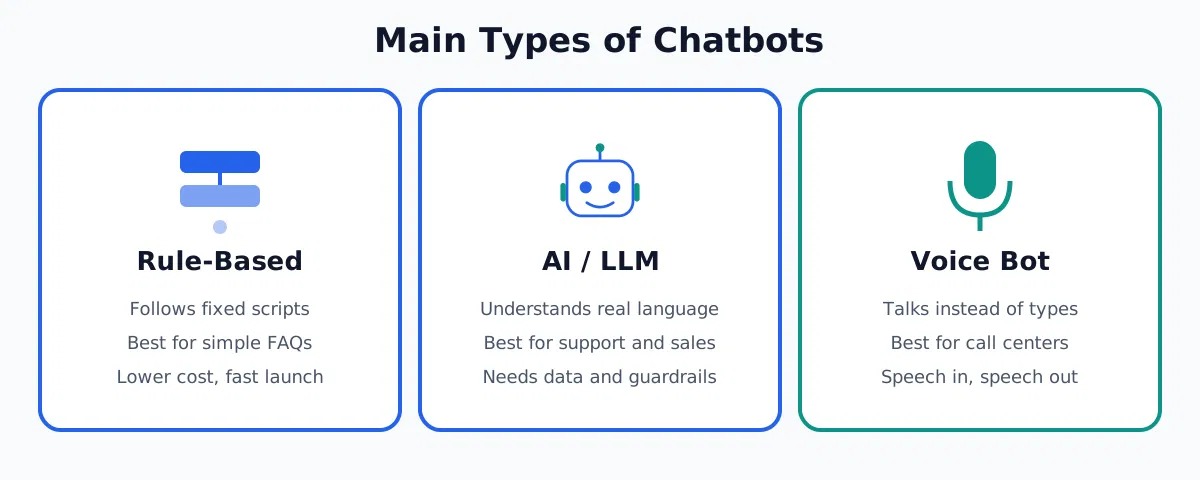
Not all bots think the same way. Also, each type fits a different need. The right choice depends on your goal, your budget, and how complex your customer questions are.
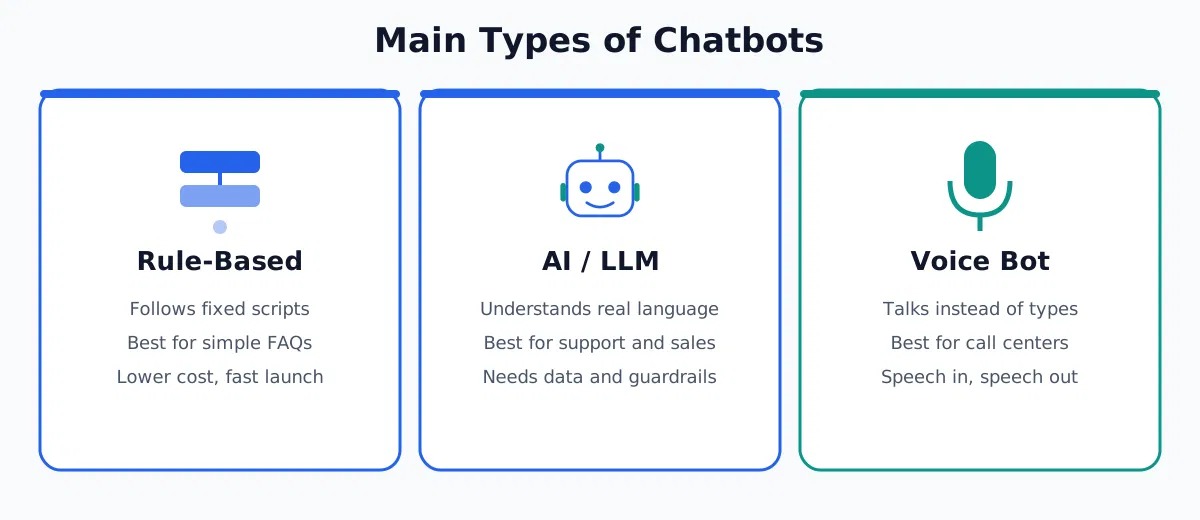
Rule-Based Chatbots
A rule-based bot follows a script. For example, if a user clicks "Pricing," the bot shows the pricing answer. It works well for short, predictable tasks. Plus, it is simple to launch and easy to control.
However, it cannot handle questions it was not built for. As a result, users often get stuck. Then they leave, or they ask for a human.
AI and LLM Chatbots
An AI chatbot uses a large language model (LLM) to understand free-form questions. It reads the meaning, not just the keywords. Because of this, it can handle long, messy, real-world chats.
It can also pull answers from your own documents. In addition, it can improve over time with feedback. Still, it needs good data and strong guardrails. Otherwise, it may give a wrong or off-brand answer.
Voice Chatbots
A voice bot talks instead of types. It answers phone calls, takes orders, and routes callers. First, it turns speech into text. Then it finds the answer and speaks back in a natural voice.
Voice bots are popular in call centers and clinics. Also, they help people who prefer to talk rather than type.
Rule-Based vs. AI Chatbots
The table below shows how the two main types compare.
| Feature | Rule-Based Chatbot | AI / LLM Chatbot |
| How it works | Follows fixed scripts and buttons | Understands natural language |
| Best for | Simple FAQs, menus, lead forms | Support, sales, complex questions |
| Handles new questions | Poorly | Well |
| Setup time | Short | Longer |
| Upfront cost | Lower | Higher |
| Upkeep | Manual script updates | Needs data and quality checks |
| Risk of wrong answers | Low, but limited | Needs guardrails and testing |
In short, pick a rule-based bot for simple, fixed tasks. Pick an AI bot when your customers ask many different questions.
Chatbot vs. AI Agent
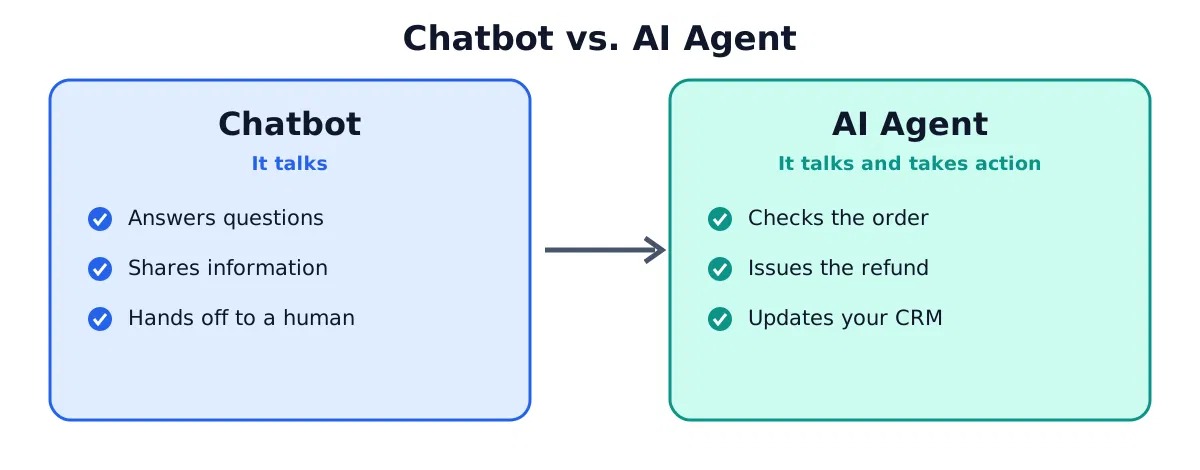
People often mix up these two terms. A chatbot mainly talks. An AI agent talks and also takes action. For instance, an agent can check an order, issue a refund, and update your CRM without help from a person.
Therefore, if you only need answers, a chatbot is enough. If you need tasks completed end to end, ask your provider about an AI agent. You can learn more in our guide on AI agents as digital coworkers.
Popular Chatbot Platforms and Technologies
Developers choose tools based on the project. Here are the most common options.
| Tool | Type | Good for |
| Google Dialogflow | Cloud platform | Multi-channel bots with intent detection |
| Rasa | Open-source framework | Custom bots with full data control |
| OpenAI / LLM APIs | AI models | Natural, free-form conversations |
| Botpress and Voiceflow | Low-code builders | Fast prototypes and simple flows |
| Microsoft Bot Framework | Developer framework | Bots inside Microsoft tools |
Importantly, the tool matters less than the design. A strong team picks the platform that fits your data, your budget, and your security needs.
Chatbot Development Process, Step by Step
A clear process keeps a project on time. It also keeps costs under control. Here is how a typical build flows.
- Discover. Define your goals, users, and top questions. For example, you might want to cut support tickets by 30%.
- Design. Map the chat flow. Also write the bot's voice and its backup replies.
- Build. Develop the bot. Then connect it to your data, website, and apps.
- Test. Check answers for accuracy. In addition, try odd questions and edge cases.
- Launch. Go live on your site, app, or phone line. Start small if you can.
- Improve. Read chat logs each week. Then fix gaps and add new skills.
Notice that the last step loops back to design. That is because a chatbot is never truly "done." Customers change, and so should your bot. Therefore, plan for steady updates from the start.
Also, do not skip testing. Many bad bots fail here. A short test with real users often reveals gaps that the team missed. So, fix those gaps before you go live.
Chatbot Development Services We Offer at Artilence
At Artilence, we build chatbots that fit real business needs. Our team covers the full project, from the first workshop to long-term support. Here is what we offer.
- Custom AI chatbots: LLM-powered bots trained on your own content, with guardrails.
- Rule-based chatbots: Fast, low-cost bots for FAQs, menus, and lead forms.
- Voice bots: Phone bots that answer calls and route callers.
- Integrations: Links to your CRM, help desk, billing, and scheduling tools.
- Workflow automation: Bots that complete tasks, not just chat, through our AI automation services.
- Full-stack builds: Web and app interfaces built by our full-stack development team.
- Security and compliance: Privacy-first design for healthtech and other regulated fields.
- Support after launch: Monitoring, reporting, and ongoing improvements.
See our work: Browse our portfolio and client reviews to see the AI and software products we have delivered.
Ready to start? Request a free chatbot consultation and we will map out the right bot for your goals.
Chatbot Use Cases
Chatbots now work in many fields. Here are four common ones.
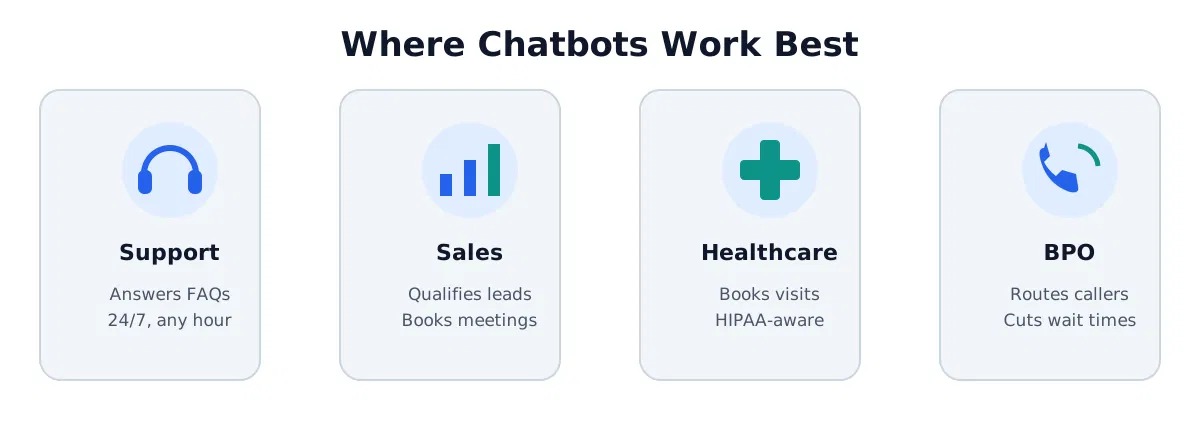
Customer Support
Bots answer common questions at any hour. For instance, they track orders, reset passwords, and share policy details. When a case is hard, they pass it to a human with the full chat history. As a result, agents spend time on problems that need real care.
Customers like this too. They get quick answers, and they do not repeat themselves.
Sales and Lead Generation
A sales bot greets visitors and asks simple questions. Next, it scores the lead and books a meeting. Because it replies in seconds, fewer leads go cold.
Moreover, it works at night and on weekends. Therefore, your team starts each morning with fresh, qualified leads.
Healthcare
Clinics use bots to book visits, send reminders, and answer basic questions. However, health data is sensitive. So any bot that handles patient details must follow privacy rules such as the HIPAA rules from the U.S. Department of Health and Human Services (HHS).
Strong security should be part of the build from day one. In addition, the bot should hand urgent cases to a real person right away.
BPO and Call Centers
Business process outsourcing (BPO) teams handle huge call volumes. A bot can take the first step by checking the caller's identity and gathering the issue. Then it routes the case to the right agent.
This cuts wait times and lowers the cost per contact. Also, agents get a clear summary before they pick up. So, calls move faster.
Chatbot Development Services Cost in 2026
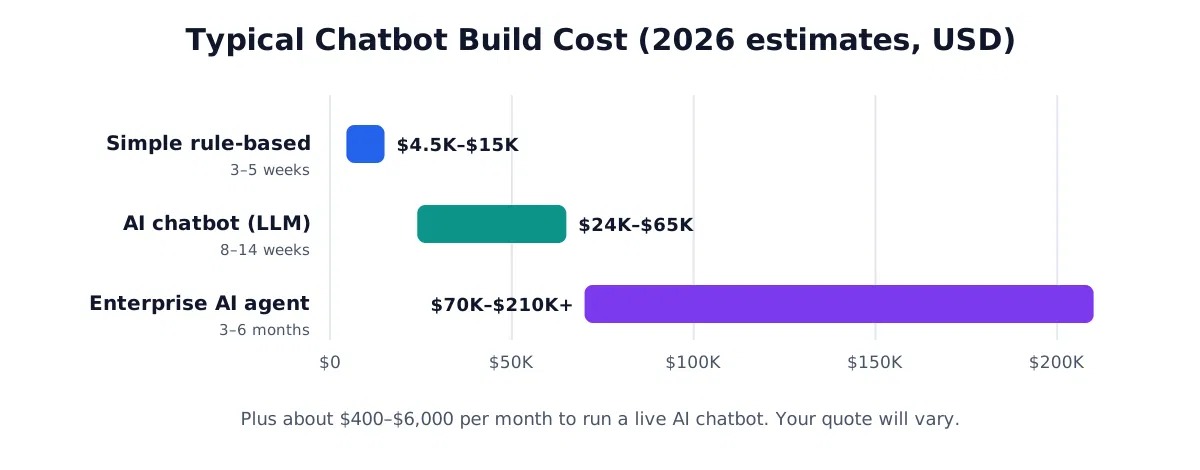
There is no single price for a chatbot. Still, market guides give useful ranges. The figures below are typical 2026 estimates. Your quote will vary by scope, integrations, and security needs.
| Chatbot type | Typical build cost | Typical timeline |
| Simple rule-based bot | About $4,500 to $15,000 | 3 to 5 weeks |
| AI chatbot with LLM and a few integrations | About $24,000 to $65,000 | 8 to 14 weeks |
| Enterprise AI agent with deep integrations | About $70,000 to $210,000+ | 3 to 6 months |
Ranges are based on 2026 cost guides such as RaftLabs' chatbot cost breakdown. Other providers publish higher and lower figures, so always compare line-by-line quotes.
Running costs matter too. A live AI chatbot can add roughly $400 to $6,000 per month for hosting, AI usage fees, monitoring, and updates, according to the same guide.
Five main factors drive the price:
- Type of bot: AI bots cost more than rule-based bots.
- Scope: More topics and languages mean more work.
- Integrations: Each system you connect adds time.
- Data and training: Cleaning your content takes effort.
- Security needs: Healthcare and finance need extra safeguards.
It also helps to think about return, not just price. For example, count how many chats the bot can close without a human. Then multiply that by the cost of one support contact. In many cases, the savings show up within the first year. However, results vary, so set a clear target before you start.
How to Choose Chatbot Development Services
When you compare providers, look for these signs:
- Relevant experience. Ask for examples in your industry.
- A clear process. They should explain each step in plain words.
- Security habits. Ask how they protect your data.
- Honest limits. A good team tells you what a bot cannot do.
- Support after launch. Look for plans to monitor and improve.
- Clear ownership. Make sure you own your bot, data, and code.
- A line-by-line quote. Ask which costs are one-time and which repeat each month.
Finally, start with one focused use case. Prove the value. Then grow from there. Ready to scope your project? Talk to our team and we will map out the right bot for your goals.
FAQs
How much do chatbot development services cost?
A simple rule-based bot often costs about $4,500 to $15,000. A custom AI bot usually costs more, from roughly $24,000 to $65,000 or higher. The price depends on the bot type, the number of integrations, and your security needs. Always ask for a quote that splits build costs from monthly running costs.
How long does it take to build a chatbot?
A simple bot can take three to five weeks. An AI bot with several integrations usually takes eight to fourteen weeks. Clear goals and ready content speed up the work.
What is the difference between a chatbot and a virtual assistant?
A chatbot usually handles one job, like support or lead capture. A virtual assistant does more. It can handle many tasks across apps, such as booking, searching, and reminders. In practice, the line is blurry, and many modern AI chatbots act like assistants.
Can a chatbot replace human agents?
Not fully. Bots are great at repeat questions and fast replies. However, people are still better at complex, sensitive, or emotional cases. The best setup lets the bot handle the simple work and hand off the rest.
Is an AI chatbot safe for sensitive data?
It can be, if it is built the right way. Look for encryption, access controls, and clear data rules. In regulated fields like healthcare, confirm that the provider follows laws such as HIPAA before you share any patient data.
Which platform is best for chatbot development?
There is no single best platform. Dialogflow suits multi-channel bots, Rasa suits full data control, and LLM APIs suit natural conversations. A good provider picks the tool that fits your goals, data, and budget.
Artilence Newsletter
Don't worry your email is secure with us, We will use it to share the latest updates straight to your inbox!
By subscribing, you agree to our Privacy Policy.
Ready to Build Something Great?
Book a free strategy call with our team and let's turn your idea into reality.
Related Insights



AI is our language, we speak it fluently. Let's innovate together.


Services
Artilence Newsletter
Don't worry your email is secure with us, We will use to share latest updates straight to your inbox!
By subscribing, you agree to our Privacy Policy.


