


Ready to Build Something Great?
Book a free strategy call with our team and let's turn your idea into reality.
Share This Blog
For the past few years, AI was something you used — you asked it a question, it gave you an answer.
That era is over.
In 2026, AI doesn't wait to be asked. It plans, acts, learns, and delivers results across your entire business — without constant hand-holding.
We call them AI agents, and they're the most important shift in how work gets done since the internet.
If you're a founder, developer, or business owner trying to make sense of what's real vs. hype right now — this post is for you.
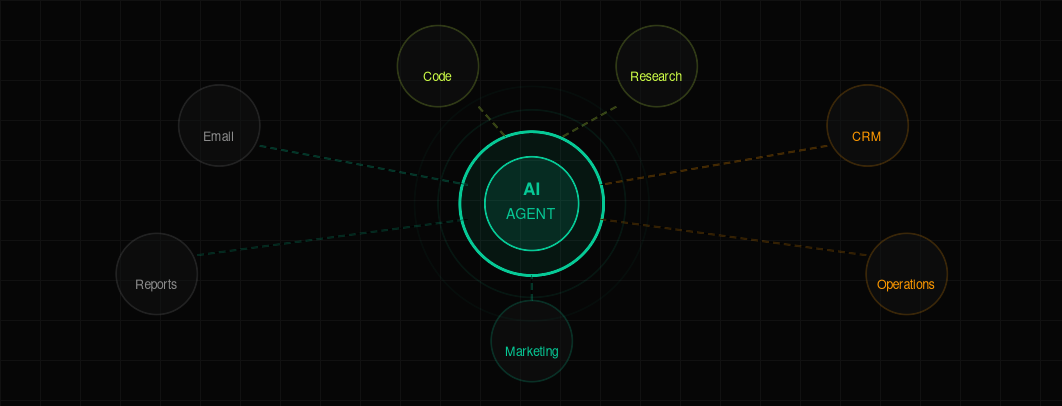
So What Exactly Is an AI Agent?
Think of a traditional AI tool like a vending machine.
You put in a request → you get an output.
An AI agent is more like a junior employee with a laptop, internet access, and a task list.
It can:
- browse the web
- write code
- send emails
- generate reports
- update your CRM
- retry tasks when something fails
—all on its own.
Key difference:
Traditional AI tools respond to prompts.
AI agents pursue goals.
They break down tasks, choose tools, execute step-by-step, and adapt when things don't go as planned.
In 2026, these systems have moved from demos to production.
Enterprises are deploying them in:
- customer service
- software development
- operations
- finance
—not as experiments, but as revenue-generating infrastructure.
AI Agent Market Signals
| Metric | Stat |
|---|---|
| Projected AI agent market by 2034 | $200B |
| Enterprises reporting gaps between AI ambition and reality | 63% |
| Companies already using AI in at least one function | 88% |
The Tools That Are Actually Working Right Now
Here are four AI agent platforms making real impact in 2026.
Salesforce Agentforce 3.0
Manages the entire customer lifecycle autonomously.
Anticipates customer needs before they arise — not just a support bot.
Zapier Agents
AI teammates working across your entire app stack.
Examples:
- drafting emails
- generating reports
- syncing data
- automating workflows
—all without manual triggers.
Google Antigravity
Agents embedded directly into the software development environment.
They can:
- plan features
- write code
- test software
- validate results
with minimal human intervention.
Beam AI
Agents that learn from every interaction.
This solves one of the biggest problems in enterprise AI deployments:
ongoing maintenance and improvement.
Where AI Is Already Solving Real Problems
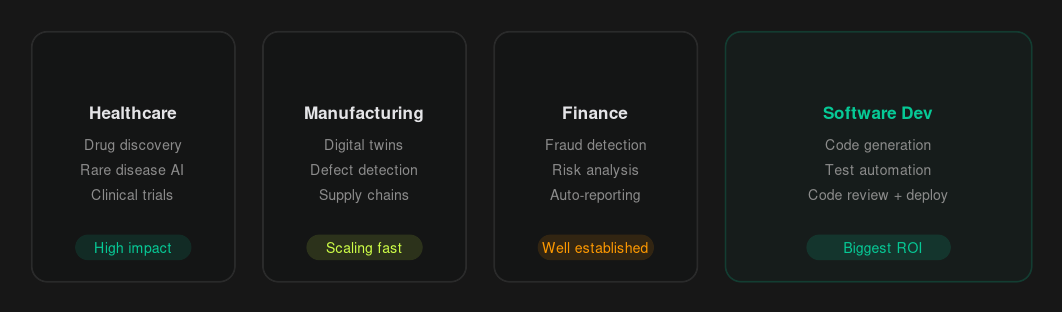
Healthcare
AI is no longer just summarizing research.
It's actively helping discover new drugs.
AI-discovered drug candidates are already entering mid-to-late stage clinical trials, particularly in:
- oncology
- rare diseases
Manufacturing
Companies like PepsiCo are using AI-powered digital twins.
Factories are simulated digitally before physical production begins.
This identifies up to 90% of potential issues before deployment.
Software Development
This may be the biggest impact area.
AI agents can now:
- write code
- test applications
- review pull requests
- deploy systems
dramatically reducing build cycles and freeing engineers to focus on higher-level problems.
What This Means for Your Business
"The question is no longer if your business should use AI — it's how fast you can integrate it before your competitors do."
Here's the uncomfortable reality:
- 88% of companies say they use AI
- only 39% report meaningful bottom-line impact
The difference isn't access to tools.
It's implementation.
Off-the-shelf AI rarely fits real business workflows.
Custom-built, integrated AI does.
Digital Agencies
Agencies are quietly becoming one of the biggest adopters of AI agents — not as a gimmick, but as a way to cut delivery time without hiring more people.
AI agents are already stepping in as AI coworkers for digital agencies, handling the repetitive work that used to eat up account teams:
- drafting client reports and performance summaries
- generating campaign copy and ad variants
- managing content calendars across multiple clients
- automating client onboarding and status updates
- pulling and formatting analytics dashboards
For agencies juggling dozens of client accounts, this isn't about replacing strategists — it's about giving every account manager a tireless assistant that handles the busywork so the team can focus on strategy and client relationships.
Most businesses are stuck in what we call the AI messy middle.
They've:
- bought subscriptions
- tested pilots
- experimented with tools
But they haven't done the hard work of integrating AI into real operational workflows.
The companies pulling ahead are not necessarily the ones with the largest AI budgets.
They're the ones working with teams that understand both:
- the technology
- the business context
well enough to build solutions that actually stick.
AI agents are not science fiction.
And they are no longer only for the Fortune 500.
The infrastructure is mature.
The tools are production-ready.
The window to gain a real competitive advantage — before every company adopts this — is still open.
But not for long.
— The Artilence Team
https://artilence.com
Artilence Newsletter
Don't worry your email is secure with us, We will use it to share the latest updates straight to your inbox!
Ready to Build Something Great?
Book a free strategy call with our team and let's turn your idea into reality.
Related Insights



AI is our language, we speak it fluently. Let's innovate together.


Services
Artilence Newsletter
Don't worry your email is secure with us, We will use to share latest updates straight to your inbox!


